Greece should have defaulted several years ago rather than have raised taxes

John Cochrane is the latest to join the list of economists who pointed out that Greece should have defaulted several years ago rather than put up taxes. Tax rises just made everything worse and put off the day when Greece had to reform through deregulation and privatisation.
image

Source: Renowned U.S. Economist Says High Taxes Squash Greece’s Prospects for Recovery | GreekReporter.com.

As early as 2011 , Jeffrey Miron was arguing the best way forward for Greece was to default and leave the Euro:

If Greece defaults, the country gets immediate relief from the crushing interest payments on its debt, leaving it with a relatively modest primary deficit which excludes the big interest payments Greece is faced with now.

In such a scenario, the pressure for austerity would therefore diminish. This would allow Greece to choose policies that encourage growth, rather than ones that shrink the deficit but retard growth by imposing higher taxes.

By abandoning the euro and adopting a properly valued currency, Greece can restore its international competitiveness. This means greater employment demand from both domestic and foreign sources.

The potential negative of default is that Greece will likely lose access, for a while, to international credit markets (although it will be a much safer investment after default than it is now).

But being cut off from foreign lending for a few years is not a disaster; if anything, it might encourage cuts in the wasteful components of government spending.

A bigger risk of default is that ending the crisis might reduce pressure for Greece to address the economy’s fundamental problems: crony capitalism, a Byzantine tax code, excessive regulation, and a bloated government sector.

If Greece fails to reform, it will suffer slow growth and a new crisis soon, regardless of what it does now.

Arellano, Conesa, and Kehoe explained in Chronic Sovereign Debt Crises in the Eurozone, 2010–2012 that the post-GFC recession in many Eurozone countries created an incentive to gamble for redemption. This gamble for redemption is betting that the post-2008 recession will soon end:

  • If Greece sold more bonds to smooth government spending in the interim, and if the Greek and EU economies recover, the stronger revenue growth will pay off the enlarged Greek government debt.
  • Under some circumstances, this policy is the best that a government can do for its country, but it carries a risk!
  • If the recession goes on for too long (and it did in southern Eurozone), a government will either have to stop increasing its debt or default on its bonds.

The global bond markets will anticipate this prospect of default as a country’s government debt accumulates and will seek higher and higher interest for new bonds, and importantly, to roll over existing Greek Government bonds.

EU policies that result in lower interest rates and lower the cost of a sovereign default provide incentives for a government to gamble for redemption. The interventions taken to date by the EU and the IMF – lowering the cost of borrowing and reducing default penalties, the bailouts and the 50% write-off of the existing Greek government debts – encourage southern Eurozone governments to gamble for redemption.

Greece and a few others are gambling for redemption by betting that the recession will end soon, selling more bonds to smooth government spending in the interim, and reducing the enlarged debt if their economies recover. The Greeks initially did a fine job in squeezing huge subsidies and debt write-offs!

If the recession continues for too long, the government will have to stop increasing debt or default on its bonds. Greece has been in default in more than 50% of the time since it became independent in 1822.

Greece’s problem is that it is 119th in the 2014 index of economic freedom, just ahead of India. The World Bank ranks Greece 161st in the world for ease of registering property and 91st for enforcing contracts; it takes an average of 1,300 days to enforce a contract through the Greek courts. This low base says something about how Greek politics works and will work for some time to come.

Cristina Arellano in a recent paper pointed out that if default is inevitable, raising taxes just makes everything worse:

Fiscal defaults occur because of the government’s inability to raise tax revenues. Aggregate defaults occur even if the government could raise tax revenues; debt is simply too high to be sustainable.

In a quantitative exercise calibrated to Greece, we find that our model can predict the recent default, but that increasing taxes would not have prevented it. In fact, increasing taxes would have made the recession deeper because of the distortionary effects of taxation.
% industrialised countries at zero or near zero central bank interest rates

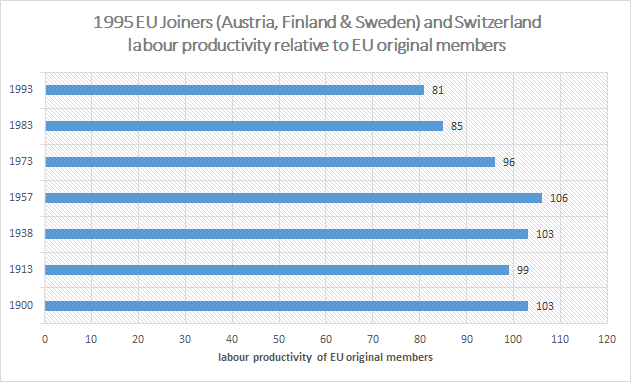
EU late joiners relative labour productivities @NickCohen4 @iainmartin1 @CapX

image

Source: Edward Prescott.

..

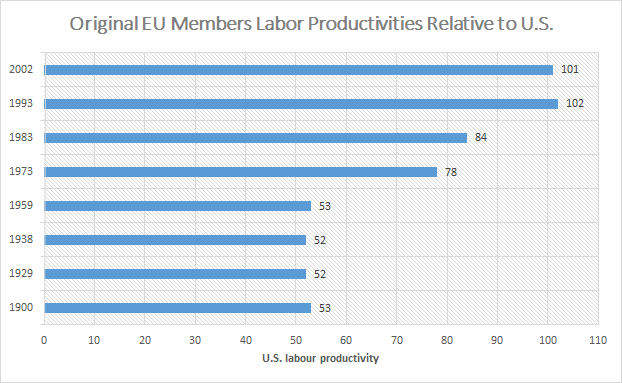
Original EU Labor Productivities Relative to U.S. @NickCohen4 @iainmartin1 @CapX

image

Source: Edward Prescott.

Eurosclerosis, Swedosclerosis, the British Disease and rising inequality harming economic growth

The Washington Centre for Equitable Growth have joined the Wall Street Journal in falling for that dodgy OECD hypothesis about rising inequality holding back economic growth.

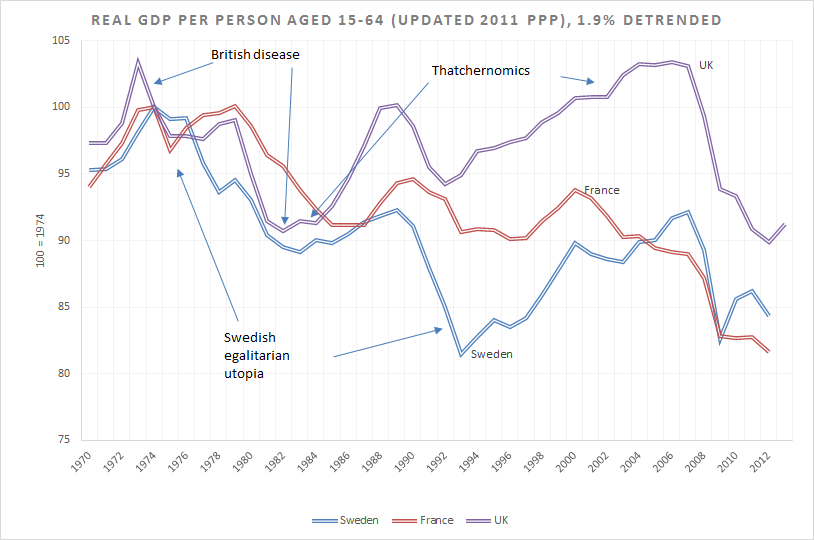
The chart below shows stark differences between egalitarian Sweden and France, and the more unequal UK since 1970 in departures from a trend growth rate of 1.9% in real GDP per working age person, PPP.

image

Source: Computed from OECD Stat Extract and The Conference Board. 2015. The Conference Board Total Economy Database™, May 2015, http://www.conference-board.org/data/economydatabase/

In the above chart, a flat line is growth at the same rate as the USA for the 20th century, which was 1.9%  for GDP per working age person on a purchasing power parity basis. The USA’s growth rate is taken as the trend rate of growth of the global technological frontier. A falling line in the above chart is growth in real GDP per working age person, PPP, at below this trend rate of 1.9%; a rising line is above trend rate growth for that year.

  • Sweden really had been the sick man of Europe until it turned its back on high taxing, welfare state socialism in the early 1990s.
  • France has been in a long decline so much so that the global financial crisis is hard to pick up in the acceleration in its long decline in the mid-1990s.

Britain did very well, both under the neoliberal horrors of Thatcherism and the betrayals by Tony Blair of a true Labour Party platform. The UK grew at above the trend annual growth to 1.9% for most of the period from the early 1980s to 2007.

Neither France or Sweden, despite their egalitarian economies, kept up with the US growth rate since 1970. Under the OECD’s hypothesis, if France and Sweden had been more unequal, their trend growth rates would have been even more appalling since 1970.

Banking crises are more common than you think

Source: Bank closures like Greece’s are rare | Pew Research Center

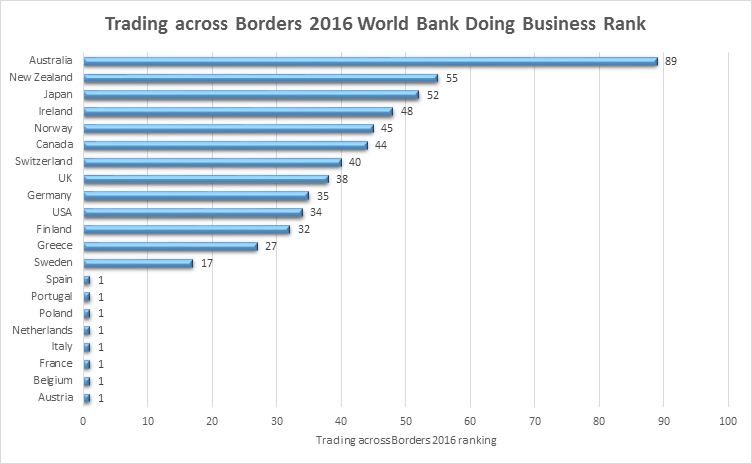
EU membership can have its advantages – Trading across Borders World Bank Doing Business rankings 2016 for OECD member countries

Australia is certainly a dog of a place when it comes to trading across borders and the same pretty much goes for New Zealand. Continental European Union members who are next to each other have a good run when it comes to trading across borders. Germans seem to manage to stuff that up nonetheless.

Source: Historical Data – Doing Business- World Bank Group.

Australia and New Zealand get a poor rating because of border charges for a processing of customs documents. In Continental Europe, where there are no border controls for land crossings between EU members, these border compliance costs obviously do not apply nor is there any waiting at border checkpoints.

Results of past EU referenda

Labour costs across the European Union

The Left is back in power in Greece

More than 15% of unemployed Europeans haven’t had a job for more than four years

The ups and downs of the Greek economy

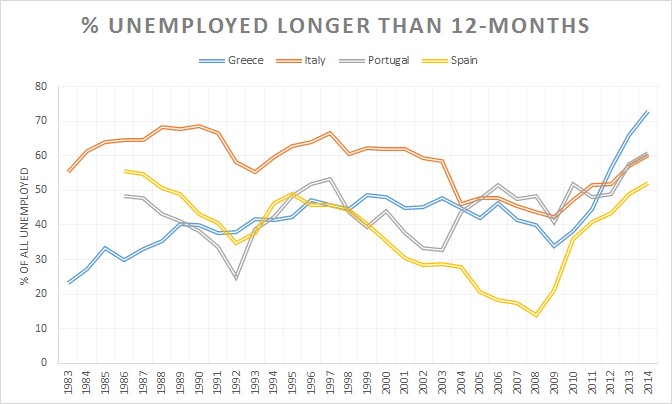
Incidence of long-term unemployment in the PIGS since 1983

The boom that preceded the bust in the Greek economy did nothing for the rate of long-term unemployment among Greeks. Long-term unemployment had been pretty stable prior to the economic boom after joining the euro currency union.

image

Source: OECD StatExtract.

Nothing much happened to long-term unemployment in Italy or Portugal in recent decades. Spanish long-term unemployment fell in line with the economic boom in Spain over the 1980s and 1990s up until the global financial crisis.

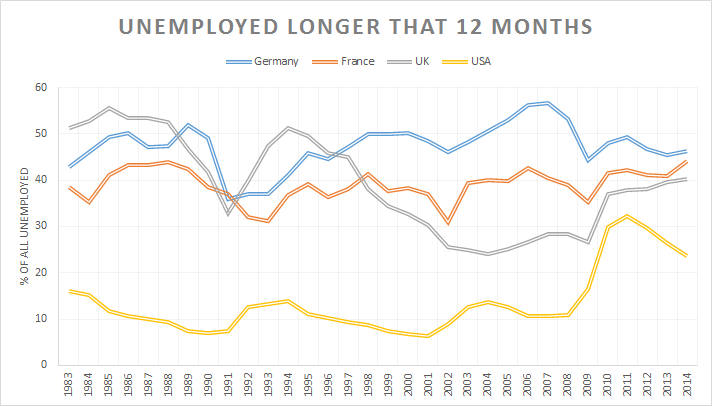
% of unemployment that is more than 12 months, USA, UK, Germany and France

As the British labour market and long-term unemployment was starting to get something like that in the USA, the USA started to have unemployment it was more like the European labour markets in terms of the number of long-term unemployed. Nothing much happened in Germany and France.

image

Source: OECD StatExtract.

Previous Older Entries Next Newer Entries

Bassett, Brash & Hide

Celebrating humanity's flourishing through the spread of capitalism and the rule of law

Truth on the Market

Scholarly commentary on law, economics, and more

The Undercover Historian

Beatrice Cherrier's blog

Matua Kahurangi

Celebrating humanity's flourishing through the spread of capitalism and the rule of law

Temple of Sociology

Celebrating humanity's flourishing through the spread of capitalism and the rule of law

Velvet Glove, Iron Fist

Celebrating humanity's flourishing through the spread of capitalism and the rule of law

Why Evolution Is True

Why Evolution is True is a blog written by Jerry Coyne, centered on evolution and biology but also dealing with diverse topics like politics, culture, and cats.

Down to Earth Kiwi

Celebrating humanity's flourishing through the spread of capitalism and the rule of law

NoTricksZone

Celebrating humanity's flourishing through the spread of capitalism and the rule of law

Homepaddock

A rural perspective with a blue tint by Ele Ludemann

Kiwiblog

DPF's Kiwiblog - Fomenting Happy Mischief since 2003

The Dangerous Economist

Celebrating humanity's flourishing through the spread of capitalism and the rule of law

Watts Up With That?

The world's most viewed site on global warming and climate change

The Logical Place

Tim Harding's writings on rationality, informal logic and skepticism

Doc's Books

A window into Doc Freiberger's library

The Risk-Monger

Let's examine hard decisions!

Uneasy Money

Commentary on monetary policy in the spirit of R. G. Hawtrey

Barrie Saunders

Thoughts on public policy and the media

Liberty Scott

Celebrating humanity's flourishing through the spread of capitalism and the rule of law

Point of Order

Politics and the economy

James Bowden's Blog

A blog (primarily) on Canadian and Commonwealth political history and institutions

Science Matters

Reading between the lines, and underneath the hype.

Peter Winsley

Economics, and such stuff as dreams are made on

A Venerable Puzzle

"The British constitution has always been puzzling, and always will be." --Queen Elizabeth II

The Antiplanner

Celebrating humanity's flourishing through the spread of capitalism and the rule of law

Bet On It

Celebrating humanity's flourishing through the spread of capitalism and the rule of law

History of Sorts

WORLD WAR II, MUSIC, HISTORY, HOLOCAUST

Roger Pielke Jr.

Undisciplined scholar, recovering academic

Offsetting Behaviour

Celebrating humanity's flourishing through the spread of capitalism and the rule of law

JONATHAN TURLEY

Res ipsa loquitur - The thing itself speaks

Conversable Economist

Celebrating humanity's flourishing through the spread of capitalism and the rule of law

The Victorian Commons

Researching the House of Commons, 1832-1868

The History of Parliament

Articles and research from the History of Parliament Trust

Books & Boots

Reflections on books and art

Legal History Miscellany

Posts on the History of Law, Crime, and Justice

Sex, Drugs and Economics

Celebrating humanity's flourishing through the spread of capitalism and the rule of law

European Royal History

Exploring the Monarchs of Europe

Tallbloke's Talkshop

Cutting edge science you can dice with

Marginal REVOLUTION

Small Steps Toward A Much Better World

NOT A LOT OF PEOPLE KNOW THAT

“We do not believe any group of men adequate enough or wise enough to operate without scrutiny or without criticism. We know that the only way to avoid error is to detect it, that the only way to detect it is to be free to inquire. We know that in secrecy error undetected will flourish and subvert”. - J Robert Oppenheimer.

STOP THESE THINGS

The truth about the great wind power fraud - we're not here to debate the wind industry, we're here to destroy it.

Lindsay Mitchell

Celebrating humanity's flourishing through the spread of capitalism and the rule of law

Alt-M

Celebrating humanity's flourishing through the spread of capitalism and the rule of law

croaking cassandra

Economics, public policy, monetary policy, financial regulation, with a New Zealand perspective

The Grumpy Economist

Celebrating humanity's flourishing through the spread of capitalism and the rule of law

International Liberty

Restraining Government in America and Around the World