Fidel Castro, wearing 2 rolexes, lighting a cigar while visiting the USSR for the first time buff.ly/1GzeezX http://t.co/ig70RuEJjw—
Business Insider (@businessinsider) June 11, 2015
Fidel Castro developed a taste for luxury early
18 Jun 2015 Leave a comment
in constitutional political economy, economics of bureaucracy, Marxist economics, Public Choice, rentseeking Tags: bribery and corruption, Cuba, fall of communism, Fidel Castro
The costs of teacher tenure in the USA
18 Jun 2015 Leave a comment
in economics of education, labour economics, labour supply, law and economics, managerial economics, occupational choice, organisational economics, personnel economics, rentseeking, unions Tags: employment protection laws
The opportunity cost of expressive politics: fossil fuels disinvestment versus actually doing something that might help
17 Jun 2015 Leave a comment
in applied price theory, applied welfare economics, comparative institutional analysis, environmental economics, global warming, politics - Australia, politics - New Zealand, politics - USA, Public Choice, rentseeking Tags: cap and trade, carbon tax, carbon trading, climate alarmism, expressive voting, fossil fuel disinvestment, global warming, rational irrationality, Robert Stavins
Every 20 years we worry about losing jobs to technology
17 Jun 2015 Leave a comment
in economics of education, entrepreneurship, human capital, industrial organisation, labour economics, labour supply, occupational choice, Public Choice, rentseeking, survivor principle Tags: antimarket bias, creative distraction, expressive voting, make-work bias, rational ignorance, rational irrationality, technological unemployment
Every 20 years we worry about losing jobs to tech. books.google.com/ngrams/graph?c… http://t.co/KW47Iwzsp9—
James Bessen (@JamesBessen) August 10, 2014

Mises on why economics analysis is so unpopular
14 Jun 2015 Leave a comment
in applied price theory, applied welfare economics, comparative institutional analysis, constitutional political economy, economics of bureaucracy, income redistribution, Ludwig von Mises, Public Choice, rentseeking Tags: antiforeign bias, antimarket bias, expressive voting, green rent seeking, makework bias, NIMBYs, rational ignorance, rational irrationality
Milton Friedman on the essence of the Age of the Worker
13 Jun 2015 Leave a comment
in applied price theory, applied welfare economics, economic growth, economic history, health and safety, income redistribution, industrial organisation, labour economics, labour supply, macroeconomics, Milton Friedman, occupational choice, politics - Australia, politics - New Zealand, politics - USA, Public Choice, rentseeking, unions Tags: competition and monopoly, The Great Enrichment, union power, union wage premium
Why the Women’s World Cup doesn’t harm host city economies the way the Men’s World Cup does
13 Jun 2015 Leave a comment
in rentseeking, sports economics Tags: is of, soccer World Cup, World Cup
Corporate welfare in New Zealand – 2015 budget update
09 Jun 2015 2 Comments
in applied price theory, applied welfare economics, comparative institutional analysis, economics of bureaucracy, industrial organisation, politics - New Zealand, rentseeking, survivor principle Tags: corporate welfare
I have updated my 2014 report on corporate welfare for the 2015 budget. My report was published today by the Taxpayers’ Union.
My key finding was that corporate welfare increased in the 7th budget of the National Party-led Government from $1.178 billion in its 2014 budget to $1.344 billion in the 2015 budget – see figure 1 and table 1.
Figure 1: Corporate welfare, Budgets 2008/09 to 2015/16

Source: New Zealand budget papers, various years.
Table 1: Corporate welfare in Budgets 2008/09 to 2015/16, $million
| 08/09 | 09/10 | 10/11 | 11/12 | 12/13 | 13/14 | 14/15 | 15/16 | |
| Arts, Culture & Heritage |
3 |
11 |
19 |
10 |
29 |
4 |
4 |
42 |
| Commerce and Consumer Affairs |
6 |
6 |
6 |
6 |
7 |
7 |
6 |
7 |
| Communications |
0 |
25 |
39 |
150 |
178 |
205 |
215 |
190 |
| Economic Development |
372 |
419 |
446 |
379 |
332 |
284 |
280 |
297 |
| Finance |
16 |
44 |
3 |
108 |
15 |
210 |
0 |
0 |
| Primary Industries |
700 |
0.3 |
14 |
0.0 |
43 |
65 |
77 |
180 |
| Science and Innovation |
0 |
4 |
0 |
0 |
0 |
112 |
219 |
269 |
| Tourism |
76 |
94 |
119 |
113 |
98 |
124 |
124 |
121 |
| Transport |
578 |
530 |
376 |
510 |
680 |
119 |
255 |
239 |
| Total $million |
1,751 |
1,134 |
1,022 |
1,277 |
1,382 |
1,130 |
1,178 |
1,344 |
Source: New Zealand budget papers, various years.
Corporate welfare has ranged between about $1 billion and $1.4 billion per year in each of the seven budgets presented by the current National-led Government – see Table 1 and Figures 1 and 2.
Figure 2: Corporate welfare, Budgets 08/09 to 15/16 by Vote
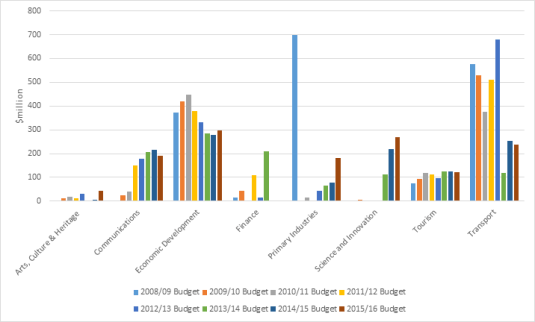
Source: New Zealand budget papers, various years; note: Vote Commerce and Consumer Affairs omitted in all years from Figure 2.
The predominant recipient of corporate welfare in this year’s budget, and all of those since 2008 is KiwiRail. Vote Transport accounts for a third of all corporate welfare – see Figures 3 and 4. Vote Economic Development is the next largest source of corporate welfare and accounts for 28% of the total since 2008 – see Figures 3 and 4.
Figure 3: Distribution of total corporate welfare across votes, 2008/09 to 2015/16

Source: New Zealand budget papers, various years.
Figure 4: State-owned enterprise welfare, Vote Transport and Vote Finance (KiwiRail), Budgets 08/09 to 15/16

Source: New Zealand budget papers, various years.
$280 – $450 million in corporate welfare has been under the patronage of the Minister for Economic Development over the last eight budgets – see Figure 5. In this year’s budget, corporate welfare under the Minister’s hand has increased slightly from $280 million to $297 million.
Figure 5: Corporate welfare, Vote Economic Development, Budgets 2008/09 to 2015/16
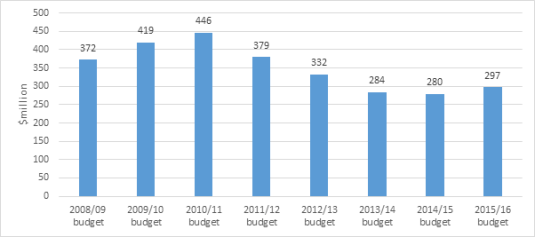
Source: New Zealand budget papers, various years.
Up until the 2013/14 budget, science and innovation spending was targeted at research that would not find private sponsors because it could not capture the returns from their discoveries – see Figure 6. Figure 6 shows that there is being rapid growth within Vote Science and Innovation of various forms of start-up and commercialisation grants in recent budgets.
Figure 6: Corporate welfare, Vote Science and Innovation, Budgets 08/09 to 15/16

Source: New Zealand budget papers, various years.
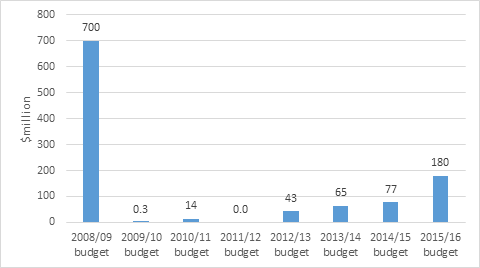
Figure 7 shows that the Government is getting back into the business of subsidising agriculture. The Primary Growth Partnership (PGP) is an R&D grants programme for the primary industry sector. There are 18 PGP programmes underway with a funding commitment from government and from industry combining to $708 million by 2017.
Figure 7: Farm welfare, Vote Primary Industries, Budgets 08/09 to 15/16
Source: New Zealand budget papers, various years.
Figure 8 shows that the National Party-led government is a major investor in ultrafast broadband – going where private entrepreneurs fear to tread.
Figure 8: Corporate welfare, Vote Communications, Budgets 08/09 to 15/16

Source: New Zealand budget papers, various years.
The corporate welfare in the Budget 2015 adds about six percentage points to the company tax rate. Should these corporate indulgences should continue or should the company tax rate drop six percentage points?
If that six percentage points on top of the company tax rate was renamed a business subsidies levy, how many businesses would want to pay it rather than developing their own business under much lower company tax rate?
The British empire was one of the last colonialists out of the block
08 Jun 2015 Leave a comment
in economic history, economics of media and culture, Public Choice, rentseeking Tags: age of empires, British empire, colonialism, imperialism

Rise of private R&D and the fall of public R&D
06 Jun 2015 Leave a comment
in applied price theory, economic history, entrepreneurship, industrial organisation, politics - USA, rentseeking, survivor principle, technological progress Tags: creative destruction, entrepreneurial alertness, private R&D, public R&D, R&D

Who had the most colonies?
05 Jun 2015 Leave a comment
in development economics, economic history, Public Choice, rentseeking Tags: age of empires, British empire, colonisation
The scramble for Africa 1880 – 1913
05 Jun 2015 Leave a comment
in comparative institutional analysis, economic history, Public Choice, rentseeking Tags: Africa, British empire, colonialism
Africa in 1880 vs. 1913 – brilliantmaps.com/africa-1914/ http://t.co/mLSSZfG0Co—
Brilliant Maps (@BrilliantMaps) May 31, 2015
A Bootleggers and Baptists alliance against e-cigarettes
03 Jun 2015 Leave a comment
in economics of regulation, Public Choice, rentseeking Tags: bootleggers and baptists, economics of smoking, meddlesome preferences, pressure groups
Should economic reform have been slower in the transitional economies?
03 Jun 2015 1 Comment
in comparative institutional analysis, constitutional political economy, development economics, economics of bureaucracy, growth disasters, growth miracles, Marxist economics, Public Choice, rentseeking Tags: collapse of communism, economics of socialism, economics of transition, former USSR, Russia


Recent Comments