The number of British fathers in a couple who worked more than 45 hours a week has dropped from about 60% to under 40% since 1998.
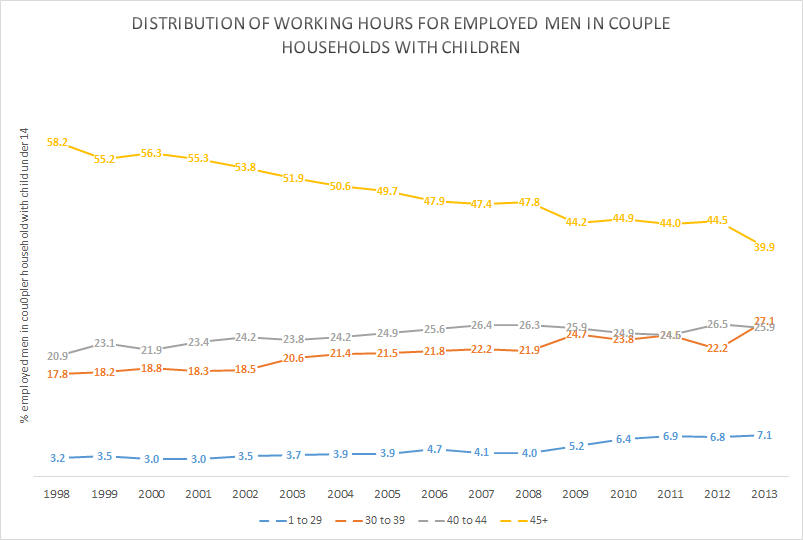
Source: OECD Family Database.
Celebrating humanity's flourishing through the spread of capitalism and the rule of law
16 Nov 2015 1 Comment
in economics of love and marriage, labour economics, labour supply Tags: asymmetric marriage premium, British economy, male labour force participation, marriage and divorce
The number of British fathers in a couple who worked more than 45 hours a week has dropped from about 60% to under 40% since 1998.
Source: OECD Family Database.
15 Nov 2015 Leave a comment
in labour economics, labour supply, occupational choice Tags: British economy, compensating differentials, Germany, health insurance, labour force participation, male labour force participation, Obamacare, part-time work, social insurance
Few men work part-time. Many that do are teenagers. Two-thirds of male workers in America, Britain and Germany work at least 40 hours a week and another quarter worked 35 to 40 hours a week except in the USA. A surprising number of Americans, 11%, worked 20 to 29 hours. If they work that 30th hour, the employer must provide them with health insurance under Obamacare.
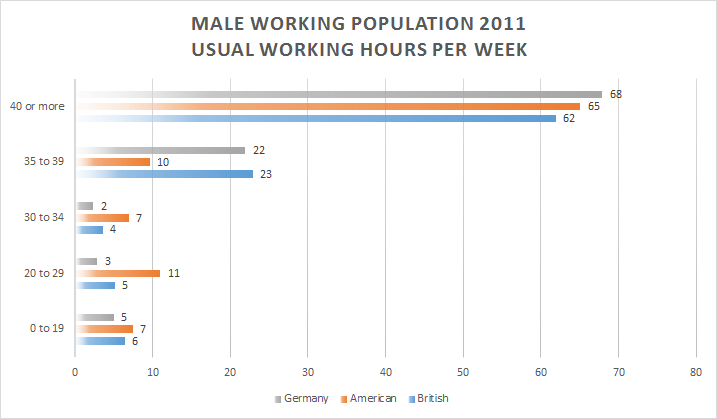
Source: OECD Family Database.
26 Sep 2015 Leave a comment
in economic history, gender, human capital, labour economics, labour supply, politics - New Zealand Tags: female labour force participation, graduate premium, male labour force participation, postgraduate premium, reversing gender gap
There was rapid growth in the human capital of graduates and postgraduates in New Zealand between 1981 and 2001 according to the census data. The growth in female human capital was particularly rapid and especially so at the postgraduate level.
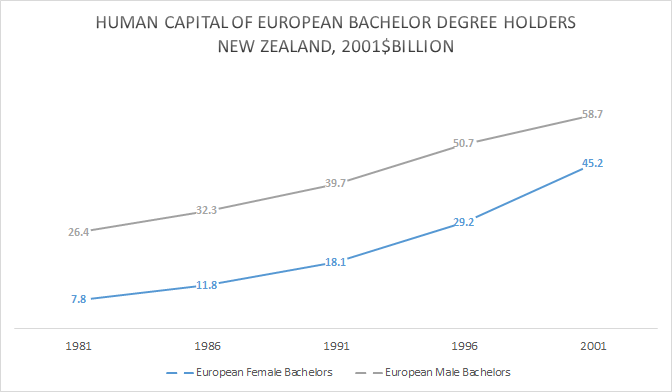
Source: Lˆe Thi. Vˆan Tr`ınh, Estimating the monetary value of the stock of human capital for New Zealand, thesis submitted in partial fulfilment of the requirements for the Degree of Doctor of Philosophy at the University of Canterbury (September 2006).
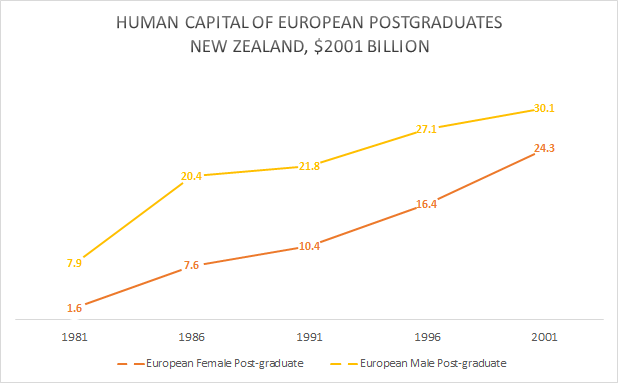
Source: Lˆe Thi. Vˆan Tr`ınh, Estimating the monetary value of the stock of human capital for New Zealand, thesis submitted in partial fulfilment of the requirements for the Degree of Doctor of Philosophy at the University of Canterbury (September 2006).
20 Sep 2015 Leave a comment
in economics of love and marriage, labour economics, law and economics, poverty and inequality Tags: asymmetric marriage premium, economics of fertility, female labour force participation, male labour force participation, marriage and divorce, maternal labour force participation, single mothers, single parents
Marriage used to be a pairing of opposites: Men would work for pay and women would work at home. But in the second half of the 20th century, women flooded the labour force, raising their participation rate from 32 percent, in 1950, to nearly 60 percent in the last decade. As women closed the education gap, the very nature of marriage has changed. It has slowly become an arrangement pairing similarly rich and educated people. Ambitious workaholics used to seek partners who were happy to take care of the house. Today, they’re more likely to seek another ambitious workaholic.


The rich and educated are more likely to marry, to marry each other, and to produce rich and educated children. But this virtual cycle turns vicious for the poor.
Source: How America’s Marriage Crisis Makes Income Inequality So Much Worse – The Atlantic
19 Sep 2015 1 Comment
in discrimination, econometerics, economic history, gender, human capital, labour economics, labour supply, poverty and inequality Tags: female labour force participation, gender wage gap, male labour force participation, middle class stagnation, middle-class stand nation, wage stagnation
Few labour markets statistics make much sense unless broken down by gender.
Women working full-time, year-round jobs earned 78.6% of what similar men did in 2014 on.wsj.com/1KlsIC8 http://t.co/amouJSkPMr—
Real Time Economics (@WSJecon) September 19, 2015
Wages growth is no exception with female wages growth quite good for a long period of time after the 1970s – a period in which male earnings stagnated.
The beginning of male wage stagnation seemed to coincide with the closing of the gender wage gap.
U.S. wage growth doesn't look as weak when you account for benefit costs covered by employers on.wsj.com/1JJ2EmV http://t.co/s0tJutTjBy—
Nick Timiraos (@NickTimiraos) July 06, 2015
Presumably if men were previously profiting from patriarchy, that should have some implications for future wage growth and promotions for men as women catch up.
Presumably if men were previously profiting from patriarchy, that should have some implications for future wage growth for men as women catch up. Men lost the wage premium they previously earned from the sex discrimination directly in hiring, wage setting and promotions and investing in more education because they expected to be discriminated favourably at the expense of women.
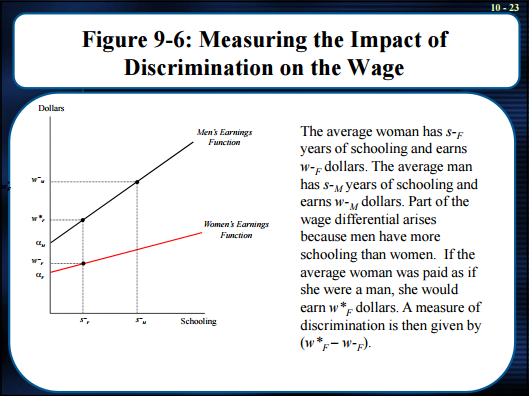
Not surprisingly the convergence in the male-female wage ratios started in the 1970s which was the decade that male wage stagnation started.

The gender wage gap started converging again also pretty much in lockstep with the top 1% starting to grab higher and higher proportions of income.
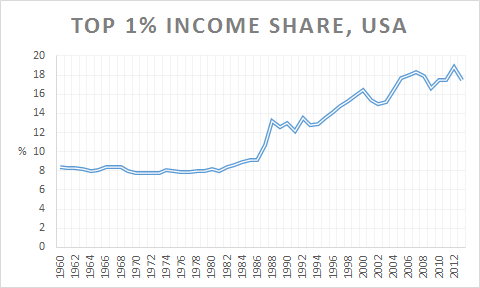
Source: Alvaredo, Facundo, Anthony B. Atkinson, Thomas Piketty and Emmanuel Saez, The World Top Incomes Database.
13 Aug 2015 Leave a comment
in business cycles, discrimination, gender, human capital, job search and matching, labour economics, labour supply, macroeconomics, occupational choice Tags: female labour force participation, male labour force participation, recessions and recoveries
CHART: The Great Recession Had a Disproportionately Negative Effect on Men That Continues Today @CHSommers @AsheSchow http://t.co/wnfdUOUn0a—
Mark J. Perry (@Mark_J_Perry) August 08, 2015
27 Jul 2015 Leave a comment
in currency unions, economic history, Euro crisis, fiscal policy, labour economics, labour supply Tags: ageing society, demographics crisis, economics of retirement, female labour force participation, Greece, Italy, male labour force participation, old age pensions, older workers, Portugal, social insurance, Social Security, Spain, taxation and labour supply
Figure 1 shows a relatively distinct pattern for men in the PIGs. Portugal aside, there has been a long decline retirement ages. This is different to the Anglo-Saxon countries where effective retirement ages have been increasing in recent years for men.
Figure 1: average effective retirement age (5-year averages), men, Portugal, Italy, Greece and Spain, 1970 – 2012
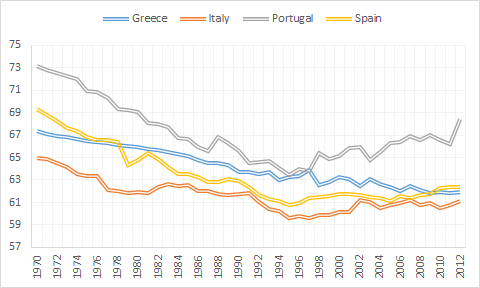
Source: OECD Pensions at a Glance.
Figure 2 shows that apart from Greece, that after a long decline in female effective retirement ages, there was something the rebound, especially in Italy and Portugal. In Greece, the rebound was in the 80s, followed by a resumption of decline from the mid 90s.
Figure 2: average effective retirement age (5-year averages), women, Portugal, Italy, Greece and Spain, 1970 – 2012
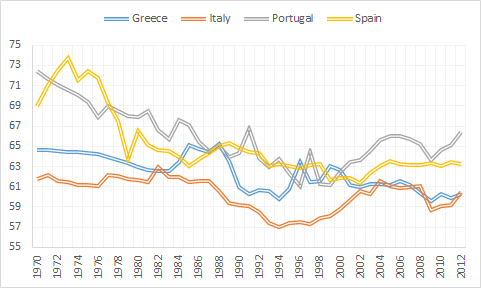
Source: OECD Pensions at a Glance.
25 Jul 2015 1 Comment
in economic history, gender, labour economics, labour supply, politics - USA Tags: ageing society, British economy, demographic crisis, economics of retirement, effective retirement ages, female labour force participation, female labour supply, France, Germany, male labour force participation, male labour supply, old age pensions, older workers, retirement ages, social insurance, Social Security, welfare state
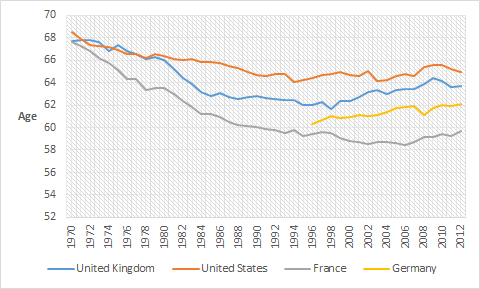
Figure 1 shows a divergence from a common starting point in 1974 effective retirement ages. The French in particular were the first to put their feet up and start retiring by the age of 60 by the early 1990. There was also a sharp increase in the average effective retirement age for men in the UK over a short decade. After that, British retirement ages for men started to climb again in the late 1990s. Figure 1 also shows that the gentle taper in the effective retirement age for American men stopped at the 1980s and started to climb again in the 2000s. The German data is too short to be of much use because of German unification. France only recently stopped seeing its effective retirement age fall and it is slightly increased recently – see figure 1
Figure 1: average effective retirement age for men, USA, UK, France and Germany, 1970 – 2012, (five-year average)
Source: OECD Pensions at a Glance.
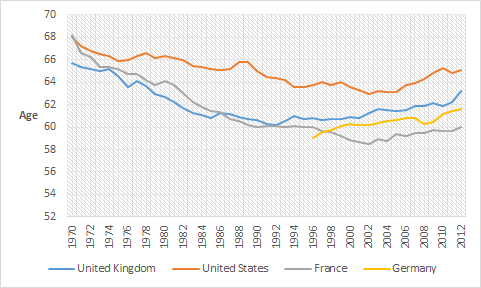
Figure 2 shows similar results for British and American women as for men in the same country shown in figure 1 . That is, falling effective retirement ages for both British and American women in the 1970s and 1980s followed by a slow climb again towards the end of 1990s. French effective retirement ages for women followed the same pattern as for French retirement ages for men – a long fall to below the age of 60 with a slight increase recently. The German retirement data suggest that effective retirement ages for German women is increasing.
Figure 2: average effective retirement age for women, USA, UK, France and Germany 1970 – 2012, (five-year average)
Source: OECD Pensions at a Glance.
24 Jul 2015 1 Comment
in economic history, labour economics, labour supply, politics - Australia, politics - New Zealand Tags: ageing society, Australia, demographic crisis, economics of retirement, effective retirement ages, female labour force participation, female labour supply, male labour force participation, male labour supply, old age pensions, older workers, retirement ages, social insurance, Social Security, welfare state
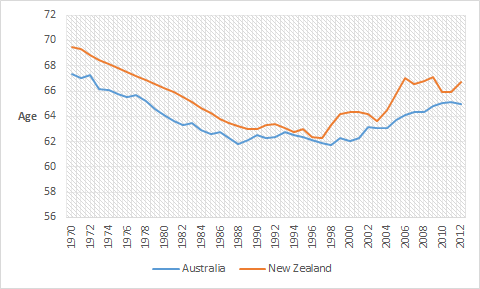
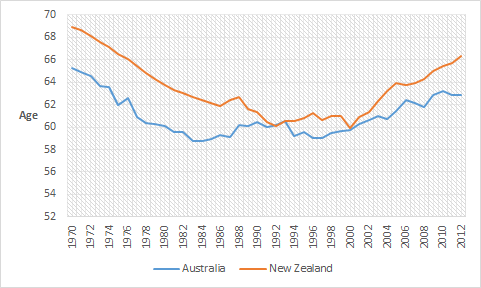
Figures 1 and 2 shows a sharp increase in the average effective retirement age for men and women in both Australia and New Zealand between 1970 and 1990. After that, retirement ages for men in both countries stabilised for about a decade. effective retirement age than Australia.
Figure 1: average effective retirement age for men, Australia and New Zealand, 1970 – 2012, (five-year average)
Source: OECD Pensions at a Glance.
Interestingly, in the 1970s and 1980s, New Zealand had an old-age pension scheme, known as New Zealand Superannuation, whose eligibility age was lowered from 65 to 60 in one shot in 1975. This old-age pension in New Zealand had no income test or assets test, but there was for a time a small surcharge on any income of pensioners. Nonetheless, New Zealand had a higher effective retirement age than in Australia where the old-age pension eligibility age is 65 with strict income and assets tests.
Figure 2: average effective retirement age for women, Australia and New Zealand, 1970 – 2012, (five-year average)
Source: OECD Pensions at a Glance.
Figure 1 and figure 2 also shows that the sharp increase in effective retirement ages in New Zealand for both men and women after the eligibility age for New Zealand’s old-age pension was increased from 60 to 65 over 10 years.
Figures 1 and 2 also show the gradual increase in effective retirement ages for Australian men and women from the end of the 1990s.
23 Jul 2015 Leave a comment
in economic history, gender, labour economics, labour supply Tags: ageing society, British economy, demographic crisis, economics of retirement, effective retirement ages, female labour force participation, female labour supply, male labour force participation, male labour supply, old age pensions, older workers, retirement ages, social insurance, Social Security, welfare state
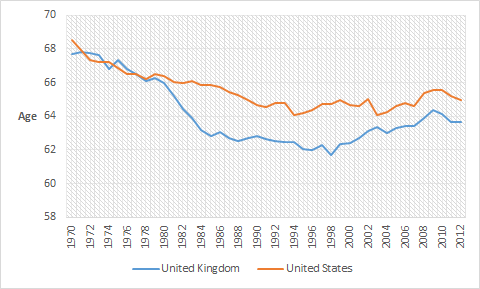
Figure 1 shows a divergence in the 1970s where there is a sharp increase in the average effective retirement age for men in the UK over a short decade. After that, British retirement ages for men started to climb again in the late 1990s. Figure 1 also shows that the gentle taper in the effective retirement age for American men stopped at the 1980s and started to climb again in the 2000s.
Figure 1: average effective retirement age for men, USA and UK, 1970 – 2012, (five-year average)
Source: OECD Pensions at a Glance.
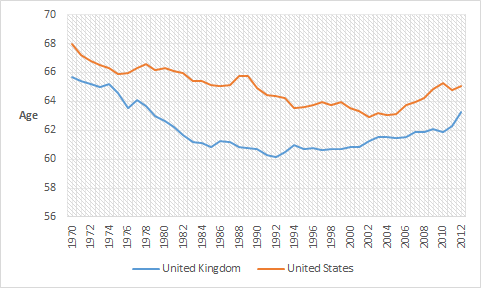
Figure 2 shows similar results to figure 1 for British and American women. That is, falling effective retirement ages for both British and American women in the 1970s and 1980s followed by a slow climb again during the 1990s.
Figure 2: average effective retirement age for women, USA and UK, 1970 – 2012, (five-year average)
Source: OECD Pensions at a Glance.
05 Jul 2015 Leave a comment
in economics of religion, labour economics, labour supply, occupational choice Tags: economics of identity, female labour force participation, Israel, male labour force participation
Haredi Jews and employment: Eat, pray, don’t work econ.st/1QVeL48 http://t.co/gxTI56rrTv—
The Economist (@EconEconomics) June 27, 2015
24 May 2015 Leave a comment
in gender, labour economics, labour supply, occupational choice, unemployment Tags: labour demographics, labour force participation, male labour force participation, reversing gender gap
NEWS FLASH: The Labor Force Participation Rate for Men Has Been Steadily Trending Downward for the last 67 Years! http://t.co/N66WJJnHsF—
Mark J. Perry (@Mark_J_Perry) May 08, 2015
18 May 2015 Leave a comment
in economics of education, gender, human capital, labour economics, labour supply, occupational choice, poverty and inequality, welfare reform Tags: child poverty, economics of marriage, family poverty, female labour force participation, labour force participation, male labour force participation, marriage and divorce, single parents, welfare reform
Helpful distinctions for family thinking: structure, stability & strength (&.. how related) @inclusionist @mboteach http://t.co/zMi92WYUhi—
Richard V. Reeves (@RichardvReeves) January 13, 2015
Celebrating humanity's flourishing through the spread of capitalism and the rule of law
Scholarly commentary on law, economics, and more
Beatrice Cherrier's blog
Celebrating humanity's flourishing through the spread of capitalism and the rule of law
Celebrating humanity's flourishing through the spread of capitalism and the rule of law
Celebrating humanity's flourishing through the spread of capitalism and the rule of law
Why Evolution is True is a blog written by Jerry Coyne, centered on evolution and biology but also dealing with diverse topics like politics, culture, and cats.
Celebrating humanity's flourishing through the spread of capitalism and the rule of law
Celebrating humanity's flourishing through the spread of capitalism and the rule of law
A rural perspective with a blue tint by Ele Ludemann
DPF's Kiwiblog - Fomenting Happy Mischief since 2003
Celebrating humanity's flourishing through the spread of capitalism and the rule of law
The world's most viewed site on global warming and climate change
Tim Harding's writings on rationality, informal logic and skepticism
A window into Doc Freiberger's library
Let's examine hard decisions!
Commentary on monetary policy in the spirit of R. G. Hawtrey
Thoughts on public policy and the media
Celebrating humanity's flourishing through the spread of capitalism and the rule of law
Politics and the economy
A blog (primarily) on Canadian and Commonwealth political history and institutions
Reading between the lines, and underneath the hype.
Economics, and such stuff as dreams are made on
"The British constitution has always been puzzling, and always will be." --Queen Elizabeth II
Celebrating humanity's flourishing through the spread of capitalism and the rule of law
Celebrating humanity's flourishing through the spread of capitalism and the rule of law
WORLD WAR II, MUSIC, HISTORY, HOLOCAUST
Undisciplined scholar, recovering academic
Celebrating humanity's flourishing through the spread of capitalism and the rule of law
Res ipsa loquitur - The thing itself speaks
Celebrating humanity's flourishing through the spread of capitalism and the rule of law
Researching the House of Commons, 1832-1868
Articles and research from the History of Parliament Trust
Reflections on books and art
Posts on the History of Law, Crime, and Justice
Celebrating humanity's flourishing through the spread of capitalism and the rule of law
Exploring the Monarchs of Europe
Cutting edge science you can dice with
Small Steps Toward A Much Better World
“We do not believe any group of men adequate enough or wise enough to operate without scrutiny or without criticism. We know that the only way to avoid error is to detect it, that the only way to detect it is to be free to inquire. We know that in secrecy error undetected will flourish and subvert”. - J Robert Oppenheimer.
The truth about the great wind power fraud - we're not here to debate the wind industry, we're here to destroy it.
Celebrating humanity's flourishing through the spread of capitalism and the rule of law
Celebrating humanity's flourishing through the spread of capitalism and the rule of law
Economics, public policy, monetary policy, financial regulation, with a New Zealand perspective
Celebrating humanity's flourishing through the spread of capitalism and the rule of law
Restraining Government in America and Around the World
 Utopia, you are standing in it!
Recent Comments