Shouldn’t @NZSuperfund be funded by earmarked taxes? @TaxpayersUnion
19 Mar 2017 Leave a comment
in fiscal policy, macroeconomics, politics - New Zealand, public economics Tags: intergenerational equity, intergenerational justice, old age pensions, sovereign wealth funds
Pre-funding of New Zealand’s old age pension obligations requires contributions to the New Zealand Superannuation Fund now, higher taxes now in return for lower taxes later through the joys of compounding of the returns on the investments. If that is so, when the contributions are not made, the $3 billion in annual taxes should not be collected.
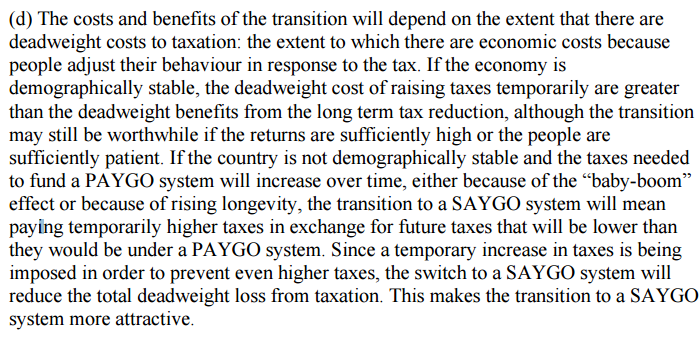
Source: Andrew Coleman, PAYGO vs SAYGO: Prefunding Government-provided Pensions, Motu Economics and Public Policy 26 Oct 2010.
There should be a separate New Zealand superannuation fund contribution levy that should lapse when contributions are suspended, as they were from 2009, and the pay-outs start after 2036? Otherwise, taxpayers will never see the promised lower taxes in the future. Never?
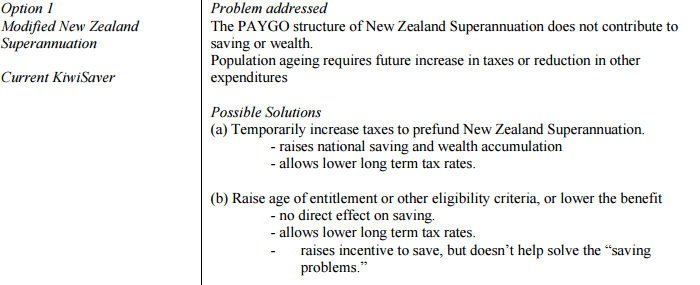
Source: Andrew Coleman Mandatory retirement income schemes, saving incentives, and KiwiSaver at http://www.treasury.govt.nz/publications/reviews-consultation/savingsworkinggroup/pdfs/swg-b-m-mris-24dec10.pdf
Constitutional political economy matters despite the reluctance of most who specialise in Social Security reform to think about that backend public choice risk. Unless there is iron-clad guarantee of lower taxes in the future, the whole deal about pre-funding superannuation pay-outs is a con.
That politicians can pass a law in 2003 to pre-fund old-age pensions 40 years hence and expect the politicians of 2036 and onwards to honour the deal with tax cuts is politically naive.
How is pension fund socialism going?
11 Dec 2016 Leave a comment
in economic history, financial economics, fiscal policy, macroeconomics Tags: ageing society, demographic crisis, economics of retirement savings, old age pensions, pension fund socialism
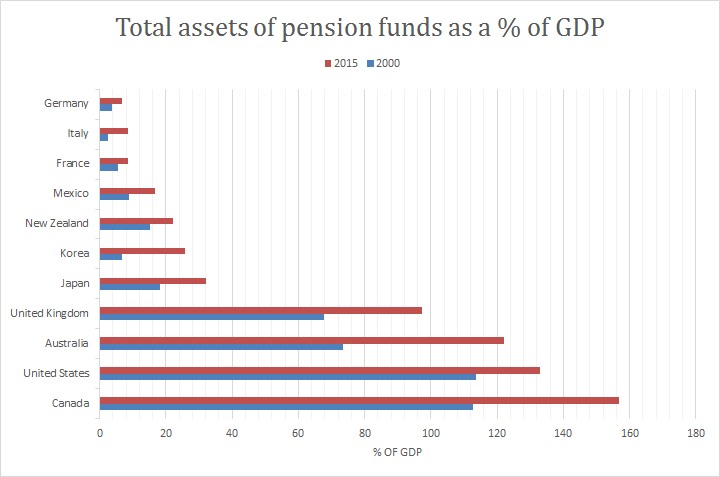
Source: OECD Pension Fund Statistics..
Viagers as a way of funding retirements
12 Sep 2016 Leave a comment
in labour economics, labour supply, poverty and inequality, welfare reform Tags: economics of retirement, French law, old age pensions, property law, reverse mortgages, social insurance
A Viager is a French way of buying and selling property. We just watched the Kelvin Klein – Maggie Smith movie about it.
Not only does the seller remain as a life tenant of the property they sold, the buyer pays them an annuity as well as a down payment. The buyer gambles as all annuity providers do on the life expectancy of the vendor. One such vendor lived to 123 in France.
Back in 1965, when Mrs Calment was aged 90, she sold her apartment in Arles to a 44-years old man, on contract-conditions that seemed reasonable given the value of the apartment and the life-expectancy statistics that prevailed at the time.
The man turned out to be unlucky since Jeanne Calment lived a very long life. He died in 1995, two years before Mrs Calment, after having paid about FFr900,000 (twice the market value) for an apartment he never lived in.
The viager system is similar to the equity release and reverse mortgage systems more familiar in Anglo-Saxon countries. The viager shares the risk of running out of equity with the buyer. The contract is between two private parties and does not involve banks or insurance companies.

Sellers are typically widows, or widowers, who want to cash out the value of their property with a lump sum – the bouquet – and a monthly payment from the buyer for the rest of their lives. The seller remains as a life tenant. The bouquet is normally 15-30% of the value of the property.
French viager investors tend to be in their late 40s and early 50s wanting to set themselves up with a retirement home and hopefully get a good deal. If the buyer dies before the seller his children will be obliged to carry on paying the viager if they want to maintain the deal. In that sense, the vendor is gambling on the buyer’s life expectancy is well.
I have no information on who is responsible for payment of rates and the maintenance of the property. The maintenance of the property would be a bigger moral hazard problem than with tenants because of the difficulties with eviction and repair. The market for Viagers is fairly small.
Should the buyer default on the monthly instalments, he is warned to pay up. After a second warning, normally within weeks, he will get a further warning and one month to get up to date with payments. If this does not happen the seller keeps keeps the bouquet, all money received so far and gets back absolute ownership of the property they sold.
This home annuity option for selling the house could be away of getting around the rather small to non-existent annuity market in New Zealand for retirees. They have the advantage of sharing the risk of exhausting the equity of the property at the price of the buyer sometimes gets a really good deal. Sellers have on average shorter survival times than the general French population.
Australian taxes on income are not particularly high if you include social security
02 Apr 2016 Leave a comment
in politics - Australia, public economics Tags: Australia, old age pensions, retirement savings, taxation and labour supply
@garethmorgannz’s #UBI finishes the job on #GenerationRent @JordNZ
29 Mar 2016 Leave a comment
in fiscal policy, labour economics, labour supply, macroeconomics, politics - New Zealand, population economics, poverty and inequality Tags: Edward Prescott, New Zealand superannuation, old age pensions, social insurance, timing inconsistency, universal basic income, welfare state
Gareth Morgan revealed today a hitherto unnoticed design feature in his Universal Basic Income of $11,000 per annum. It will be phased in over a long time. That will mean that Generation Rent will continue to pay taxes to fund a universal old age pension for their parents and grandparents, but will not be fortunate enough to receive that themselves.
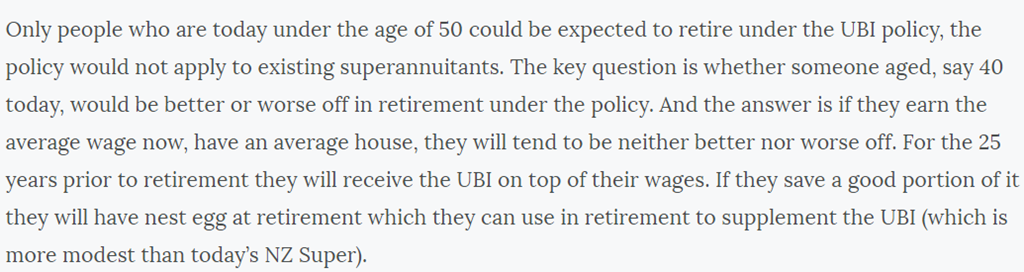
Source: Morgan Foundation (2016) Taxpayers Union Critique of the UBI just bonkers – again
They are not left of their own devices. Generation Rent is expected to save the Universal Basic Income they receive over their working lives to avoid living in poverty in their retirement. Does not strike me as a political winner.
The Morgan Foundation does not understand the implications of time inconsistency for retirement savings policy:
- Which is better? Save for your retirement through the share market or save to own your own home and then present yourself at the local social security office to collect your taxpayer funded old-age pension?
- Under this fine game of bluff, you bleed the taxpayer in your old age and pass on your debt-free home to your children.
This strategy of not saving much for retirement is rational for the less well-paid. The family home is exempt from income and asset testing for social security. If you lose you bet, sell your house and live off the capital. For ordinary workers, this is a good bet. The middle class might prefer to live in a more luxurious retirement.
For ordinary workers, whose wages are not a lot more than their old age pension from the government, a government funded pension is a good political gamble. The old-age pension for a couple in New Zealand is set at no less that 60% of average earnings.
Edward Prescott argues for compulsory retirement savings account albeit with important twists because it is otherwise irrational for many to save for their retirement against the background of a welfare state:
The reason we need to have mandatory retirement accounts is not because people are irrational, but precisely because they are perfectly rational — they know exactly what they are doing.
If, for example, somebody knows that they will be cared for in old age — even if they don’t save a nickel — then what is their incentive to save that nickel? Wouldn’t it be rational to spend that nickel instead?
…Without mandatory savings accounts we will not solve the time-inconsistency problem of people under-saving and becoming a welfare burden on their families and on the taxpayers. That’s exactly where we are now.
Expected years in retirement by gender in the G7 countries, Australia and New Zealand
19 Feb 2016 Leave a comment
in labour economics, labour supply, politics - Australia, politics - New Zealand, politics - USA Tags: ageing society, demographic crisis, old age pensions, older workers
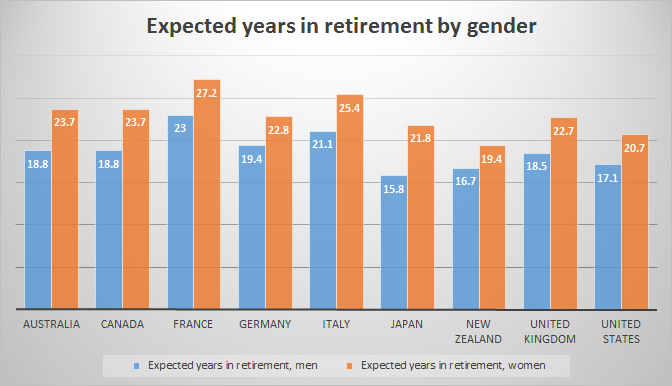
Source: OECD Pensions at a Glance 2015.
Effective labour market exit age by gender in the G7 countries, Australia and New Zealand
19 Feb 2016 Leave a comment
in labour economics, labour supply, politics - Australia, politics - New Zealand, politics - USA, population economics Tags: ageing society, gender gap, old age pensions, older workers, social insurance, welfare state
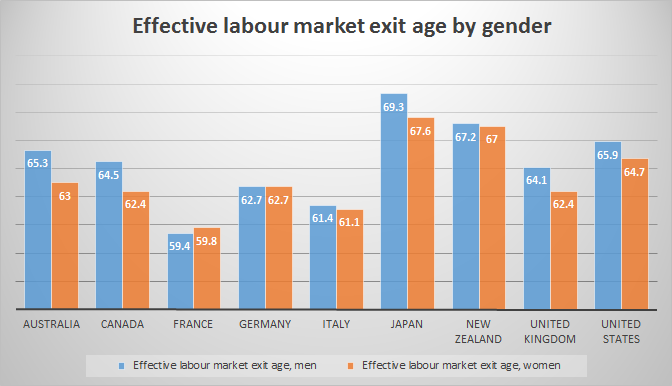
Source: OECD Pensions at a Glance 2015.
.
Female labour force participation rate, workers aged 65 to 69, US, UK, Australia and New Zealand since 1960
06 Feb 2016 Leave a comment
in gender, labour economics, labour supply, politics - New Zealand, public economics Tags: ageing society, labour demographics, old age pensions, older workers, social insurance
The phased increase in the eligibility age for the New Zealand old pension from 60 to 65 from the mid-1990s obviously carried through to the labour force participation of women over 65 as well.
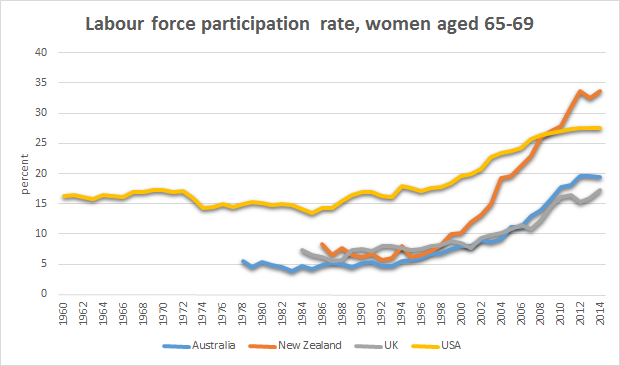
Data extracted on 05 Feb 2016 05:13 UTC (GMT) from OECD.Stat.
The rapidly approaching demographic crisis in New Zealand
16 Dec 2015 Leave a comment
in labour economics, labour supply, politics - New Zealand Tags: ageing society, demographic crisis, old age pensions
The benefits and costs of the @NZSuperFund since its inception
17 Aug 2015 Leave a comment
in applied price theory, applied welfare economics, economic growth, economic history, entrepreneurship, financial economics, fiscal policy, industrial organisation, labour economics, labour supply, macroeconomics, politics - New Zealand, public economics Tags: ageing society, company tax rate, deadweight cost of taxes, demographic crisis, efficient markets hypothesis, laffer curve, New Zealand superannuation fund, old age pensions, retirement savings, social insurance, sovereign wealth funds, taxation and entrepreneurship, taxation and investment, taxation and labour supply
Most mutual funds still can't beat their benchmark read.bi/1GkTig1 http://t.co/r7ezoDGJbV—
BI Chart of the Day (@chartoftheday) June 03, 2015
The New Zealand Superannuation Fund, the sovereign wealth fund part funding New Zealand’s old-age pension from 2029/2030 onwards, has been a bit of a wild ride. Sometimes the earnings of the Fund were well below and sometimes earning well above the long-term bond rate.
![image_thumb[3]](https://utopiayouarestandinginit.com/wp-content/uploads/2015/08/image_thumb310.png "image_thumb[3]")
Source: New Zealand Superannuation Fund Annual Report 2014.
Since its inception, the Fund earned an average annual return of 9.78%, which was 5.06% above the long-term bond rate, and 1.03% above its reference portfolio.

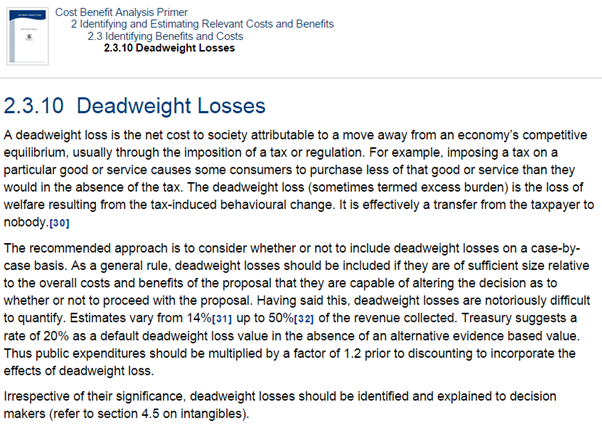
No information was given in the annual report of the New Zealand Superannuation Fund on the marginal dead weight cost of the taxes raised to fund the New Zealand Superannuation Fund to see whether there is any net benefit to taxpayers from its establishment and continued operation.
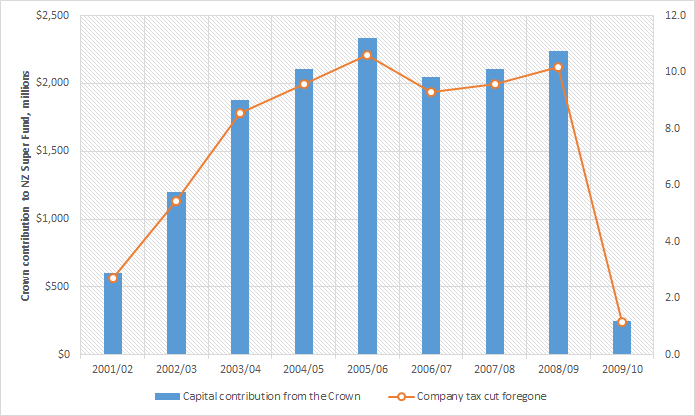
The New Zealand Government has contributed $14.88 billion to the fund from prior its inception in 2001 to the suspension of contributions in 2009 by the incoming National Party Government.
Source: New Zealand Treasury.
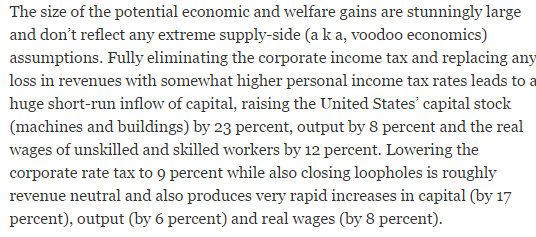
Over the nine years in which contributions were made, the company tax rate of 28% could have easily been up to 10 percentage points lower.
The New Zealand Treasury estimates that a one percentage point cut in the company tax costs about $220 million in forgone revenue if there are no other changes to the tax system. These are static estimates that do not include any feedback from greater investment and higher growth.
The New Zealand Superannuation Fund must beat the market every single year to make up for the deadweight cost of its funding, a premium for the investment risk added to the Crown’s portfolio and the cost to New Zealand’s growth rate of higher than otherwise taxes on income, entrepreneurship and investment.
Source: Abolish the Corporate Income Tax – The New York Times.
Average effective retirement age by gender in the PIGS, 1970 – 2012
27 Jul 2015 Leave a comment
in currency unions, economic history, Euro crisis, fiscal policy, labour economics, labour supply Tags: ageing society, demographics crisis, economics of retirement, female labour force participation, Greece, Italy, male labour force participation, old age pensions, older workers, Portugal, social insurance, Social Security, Spain, taxation and labour supply
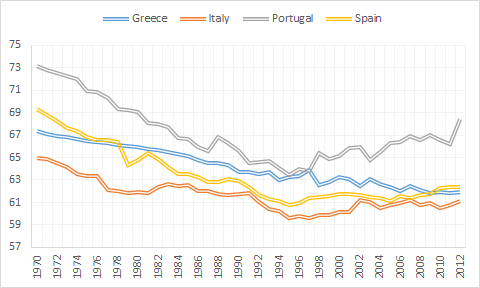
Figure 1 shows a relatively distinct pattern for men in the PIGs. Portugal aside, there has been a long decline retirement ages. This is different to the Anglo-Saxon countries where effective retirement ages have been increasing in recent years for men.
Figure 1: average effective retirement age (5-year averages), men, Portugal, Italy, Greece and Spain, 1970 – 2012
Source: OECD Pensions at a Glance.
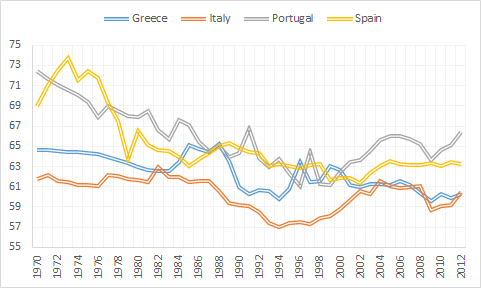
Figure 2 shows that apart from Greece, that after a long decline in female effective retirement ages, there was something the rebound, especially in Italy and Portugal. In Greece, the rebound was in the 80s, followed by a resumption of decline from the mid 90s.
Figure 2: average effective retirement age (5-year averages), women, Portugal, Italy, Greece and Spain, 1970 – 2012
Source: OECD Pensions at a Glance.
Average effective retirement ages by gender in the USA, UK, Germany and France, 1970 – 2012
25 Jul 2015 1 Comment
in economic history, gender, labour economics, labour supply, politics - USA Tags: ageing society, British economy, demographic crisis, economics of retirement, effective retirement ages, female labour force participation, female labour supply, France, Germany, male labour force participation, male labour supply, old age pensions, older workers, retirement ages, social insurance, Social Security, welfare state
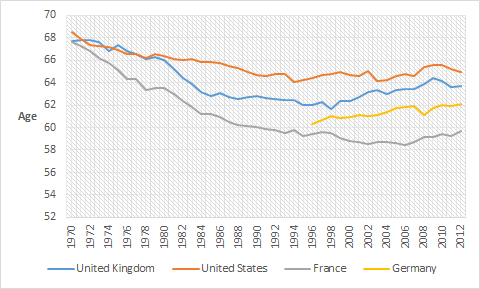
Figure 1 shows a divergence from a common starting point in 1974 effective retirement ages. The French in particular were the first to put their feet up and start retiring by the age of 60 by the early 1990. There was also a sharp increase in the average effective retirement age for men in the UK over a short decade. After that, British retirement ages for men started to climb again in the late 1990s. Figure 1 also shows that the gentle taper in the effective retirement age for American men stopped at the 1980s and started to climb again in the 2000s. The German data is too short to be of much use because of German unification. France only recently stopped seeing its effective retirement age fall and it is slightly increased recently – see figure 1
Figure 1: average effective retirement age for men, USA, UK, France and Germany, 1970 – 2012, (five-year average)
Source: OECD Pensions at a Glance.
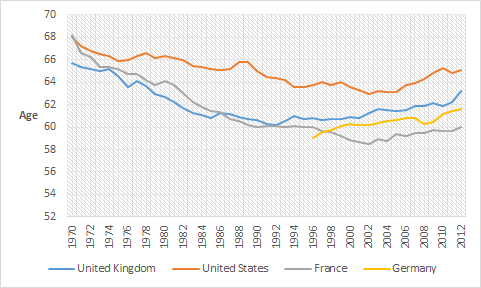
Figure 2 shows similar results for British and American women as for men in the same country shown in figure 1 . That is, falling effective retirement ages for both British and American women in the 1970s and 1980s followed by a slow climb again towards the end of 1990s. French effective retirement ages for women followed the same pattern as for French retirement ages for men – a long fall to below the age of 60 with a slight increase recently. The German retirement data suggest that effective retirement ages for German women is increasing.
Figure 2: average effective retirement age for women, USA, UK, France and Germany 1970 – 2012, (five-year average)
Source: OECD Pensions at a Glance.
 Utopia, you are standing in it!
Recent Comments