Data extracted on 23 Feb 2016 07:08 UTC (GMT) from OECD.Stat.
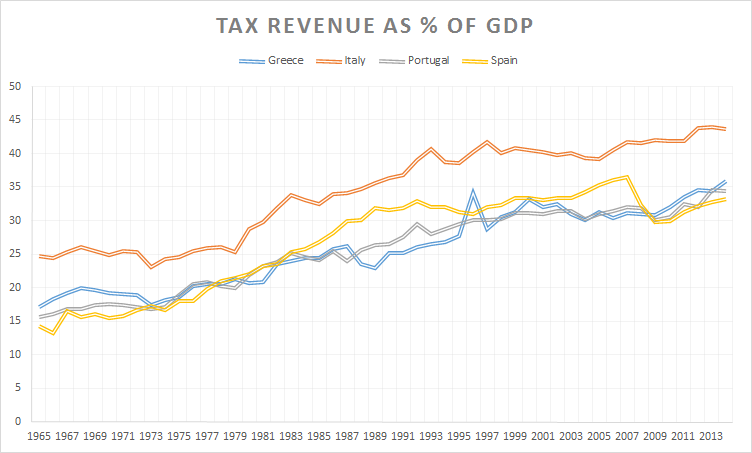
Tax revenue as % of Portuguese, Italian, Greek and Spanish GDP
23 Feb 2016 Leave a comment
in economic history, public economics Tags: Greece, growth of government, Italy, Portugal, size of government, Spain
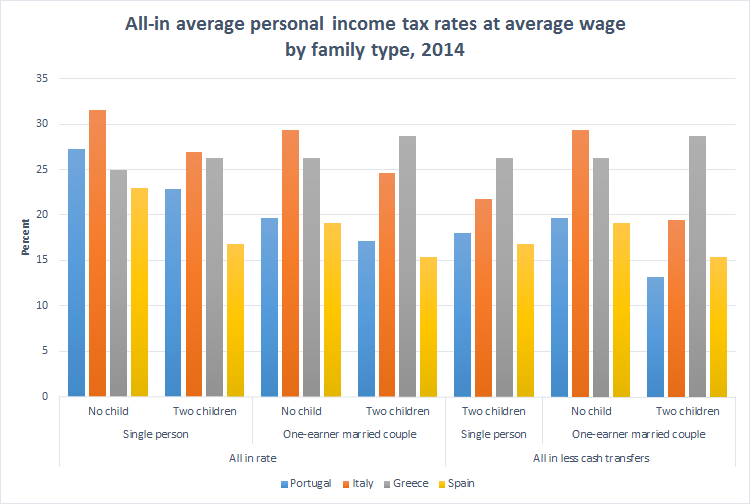
Portuguese, Italian, Greek and Spanish all-in average personal income tax rates at average wage by family type, 2014
29 Jan 2016 Leave a comment
in public economics Tags: family tax credit, Greece, in work tax credit, Italy, Portugal, Spain
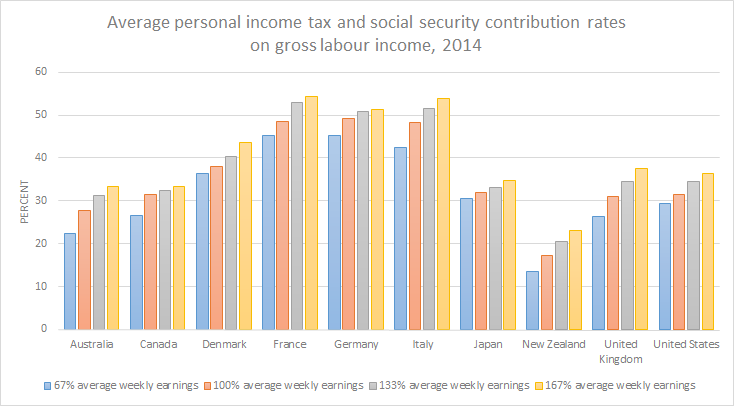
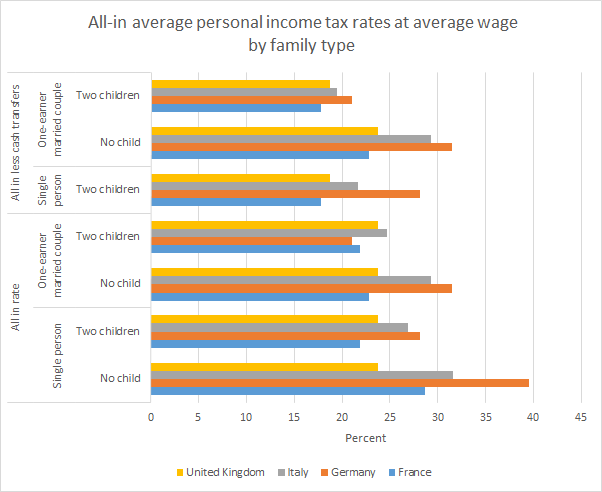
British, French, German and Italian All-in average personal income tax rates at average wage by family type
23 Jan 2016 Leave a comment
in fiscal policy, macroeconomics, public economics Tags: British economy, France, Germany, Italy, taxation and labour supply
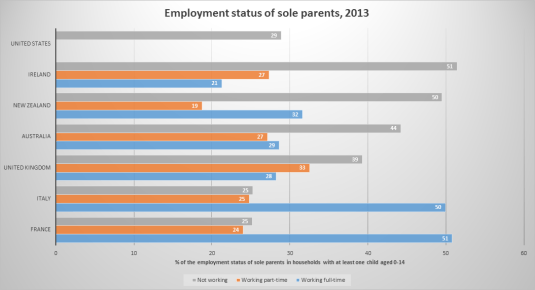
Employment status of sole parents in UK, USA, France, Italy, Australia, Ireland and New Zealand
13 Nov 2015 Leave a comment
in economics of love and marriage, labour supply, politics - Australia, politics - New Zealand, politics - USA Tags: Australia, British economy, France, Ireland, Italy, maternal labour supply, single parents, sole parents, welfare state
Despite supposedly having stingy welfare states, both New Zealand and Australia have a lot of sole parents who do not work at all. There is no separate breakdown of full-time and part-time work status in the USA. About 72% of sole parents in the USA either work full-time or part-time.

Source: OECD Family Database.
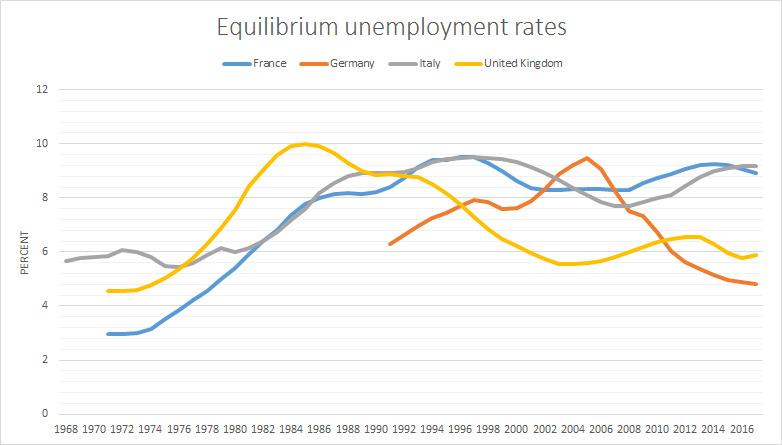
French, German, Italian and British equilibrium unemployment rates, 1968 – 2017
10 Nov 2015 Leave a comment
in business cycles, economic history, economics of regulation, Euro crisis, job search and matching, labour economics, labour supply, macroeconomics Tags: British economy, employment law, equilibrium unemployment rate, Eurosclerosis, France, Germany, Italy, labour market reforms, Margaret Thatcher, Thatchernomics, The British Disease
Unlike the USA, the German, Italian, British and French equilibrium unemployment rates all show fluctuations that reflect changes in their underlying economic circumstances and labour market reforms. The case of the British, the rise of the British disease and Thatchernomics. The case of German, its equilibrium unemployment rate rose after German unification and then fell after the labour market reforms of 2002 to 2005.
Source: OECD Economic Outlook November 2015 Data extracted on 10 Nov 2015 07:07 UTC (GMT) from OECD.Stat.
Top incomes and the decline of unions in Canada, France and Italy
03 Nov 2015 Leave a comment
in applied price theory, applied welfare economics, economic history, entrepreneurship, industrial organisation, labour economics, labour supply, Milton Friedman, poverty and inequality, Public Choice, rentseeking, unions Tags: Canada, entrepreneurial alertness, France, Italy, top 1%, union power, union wage premium
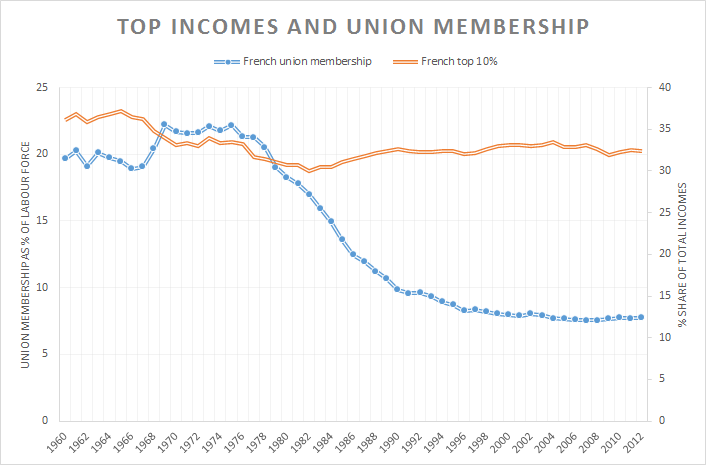
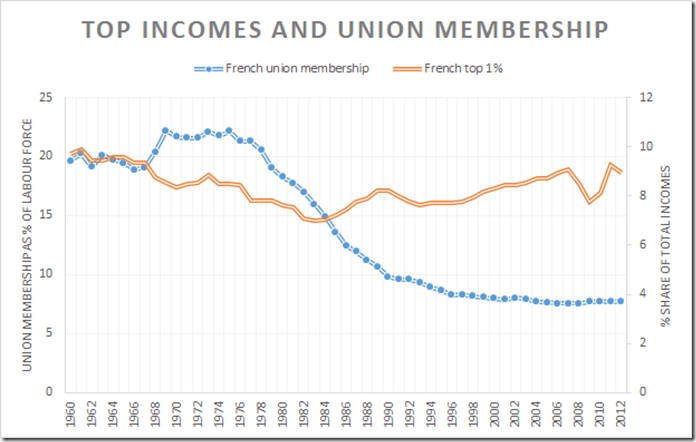
The French ruling class is as lazy as their transnational co-conspirators down under. French union membership is in serious decline albeit from a low base. An opportunity lost for the French ruling class. It has not lifted a finger to extract additional labour surplus from the downtrodden French proletariat now stripped of their only line of collective defence against capitalist exploitation.
Source: OECD Stat and Top Incomes Database.
The top 10% and top 1% in France are no better off than two generations ago despite the decline of French unions. The French Left must be most disappointed. No kicking in the rotten door of the permanent revolution anytime soon after the immiserised French proletariat rises up because it has nothing to lose but its chains. The 21st century version of the Marxist call to the barricades would be a proletariat stirred to revolution with nothing to lose but their suburban home, motorcar, IPad and air points
Source: OECD Stat and Top Incomes Database.
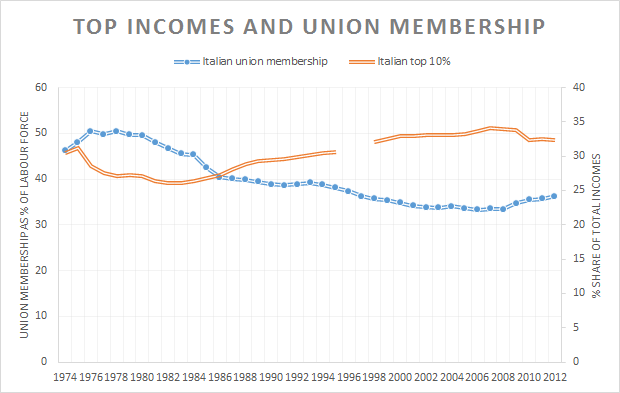
The Italian ruling class has had little success in bringing Italian unions down. The top 10% in Italy is earning no more now than back when the Red Brigades were gunning for them.
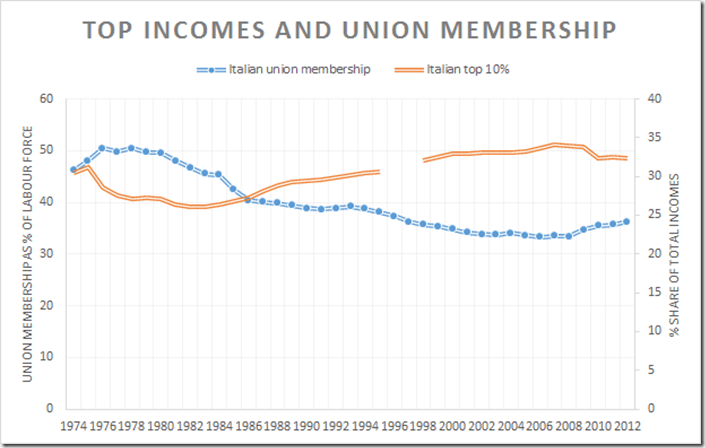
Source: OECD Stat and Top Incomes Database.
The top 1% in Italy is doing a little bit better than when the Red Brigade was gunning for them, but not much more. Unions don’t figure in explaining that small rise in Italian top 1% incomes over the last 40 years. Italian unions are pretty much a strong as they were 40 years ago in membership. Italian employment protection laws are pretty much as strong as they used to be too.
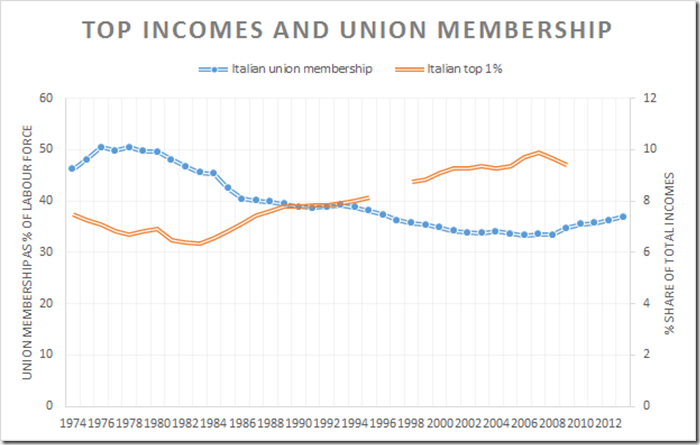
Source: OECD Stat and Top Incomes Database.
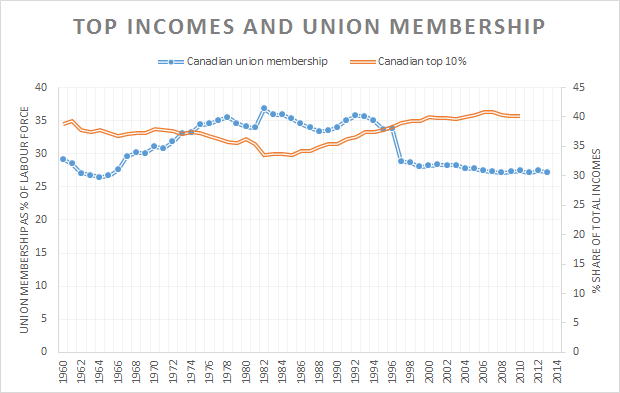
The Canadian ruling classes even more incompetent than their transnational co-conspirators over in Italy. There appears to have been next to no decline in union membership in Canada. The Canadian top 10% is not earning any more than back in the 60s.
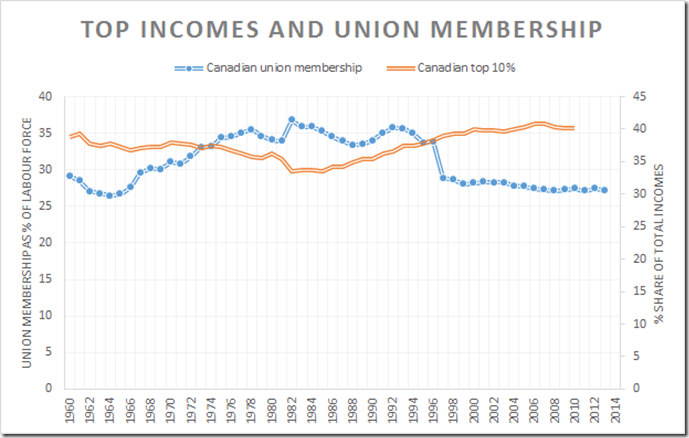
Source: OECD Stat and Top Incomes Database.
The Canadian top 1% is doing a little bit better than 25 years ago also but not off the back of unions which are almost as strong as in the past. The Canadian Left will have to look for a different hypothesis than the ravages of the top 1%.
Source: OECD Stat and Top Incomes Database.
All in all, the Economic Policy Institute simply got lucky with a spurious correlation between top incomes and union membership in the USA.
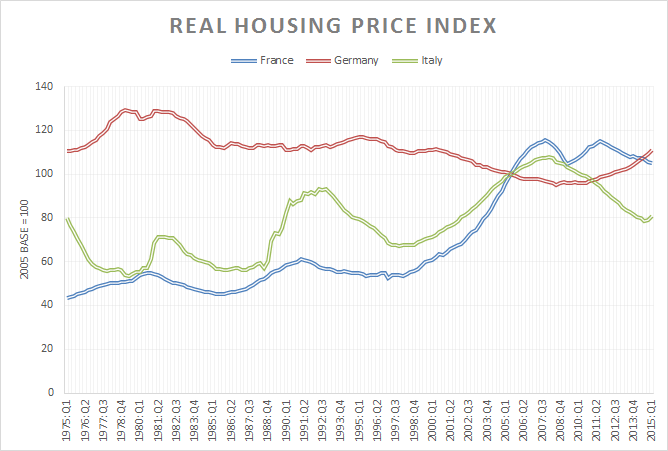
German, French and Italian real housing prices since 1975
19 Oct 2015 Leave a comment
in applied price theory, applied welfare economics, economic history, economics of regulation, rentseeking, urban economics Tags: France, Germany, housing affordability, housing prices, Italy, land supply, land use planning, zoning
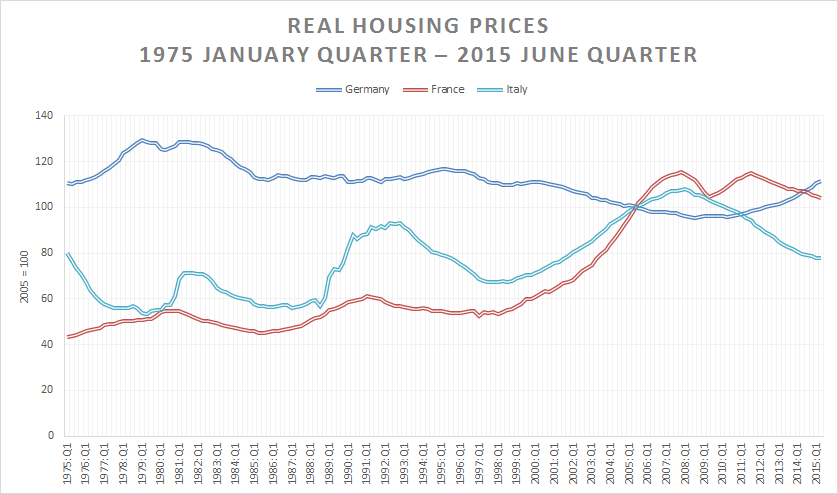
Source and notes: International House Price Database – Dallas Fed June 2015; nominal housing prices for each country is deflated by the personal consumption deflator for that country.
Why is #Italy’s productivity so much weaker
14 Oct 2015 Leave a comment
in economic history Tags: Eurosclerosis, Italy
Why is #Italy's productivity so much weaker than in the rest of Europe? V sharp divergence. ecb.europa.eu/press/key/date… http://t.co/pGFP5u6ACS—
Angel Ubide (@AngelUbide) May 22, 2015
No Generation Rent in #Deutschland! Real housing prices in #Germany, #France & #Italy since 1975
14 Sep 2015 Leave a comment
in economic history, urban economics Tags: France, Generation Rent, Germany, housing affordability, housing prices, Italy, land supply, land use planning, NIMBYs, zoning
Source: International House Price Database – Dallas Fed
Note: The house price index series is an index constructed with nominal house price data. The real house price index is an index calculated by deflating the nominal house price series with a country’s personal consumption expenditure deflator.
Vanishing effect of #religion on the labour market participation of European women
19 Aug 2015 Leave a comment
in economics of religion, gender, human capital, labour economics, labour supply, occupational choice, poverty and inequality, welfare reform Tags: female labour force participation, female labour supply, France, gender gap, Germany, Greece, Italy, Portugal, Spain, Turkey
Vanishing effect of #religion on the labor market participation of European women newsroom.iza.org/en/2015/08/10/… http://t.co/25nx8NiEfk—
IZA (@iza_bonn) August 10, 2015
Incidence of long-term unemployment in the PIGS since 1983
17 Aug 2015 Leave a comment
in business cycles, currency unions, economic growth, economic history, Euro crisis, job search and matching, labour economics, labour supply, macroeconomics, occupational choice, unemployment, unions, welfare reform Tags: employment law, equilibrium unemployment, Greece, Italy, labour market regulation, natural unemployment rate, Portugal, Spain, unemployment duration
The boom that preceded the bust in the Greek economy did nothing for the rate of long-term unemployment among Greeks. Long-term unemployment had been pretty stable prior to the economic boom after joining the euro currency union.
Source: OECD StatExtract.
Nothing much happened to long-term unemployment in Italy or Portugal in recent decades. Spanish long-term unemployment fell in line with the economic boom in Spain over the 1980s and 1990s up until the global financial crisis.
Recent Comments