@garethmorgannz the @TaxpayersUnion #UBI report isn’t bonkers @JordNZ

A clever man can climb out of the hole a wise man would not have fallen into. In responding to my Taxpayers’ Union paper on a Universal Basic Income, Gareth Morgan just kept digging.

image

His first response was to say a Universal Basic Income would not be implemented immediately. This avoids retirees taking home $50 per week less than currently under NZ Superannuation.

Gareth Morgan’s solution is to say that only those currently under 50 will have to rely on a Universal Basic Income.

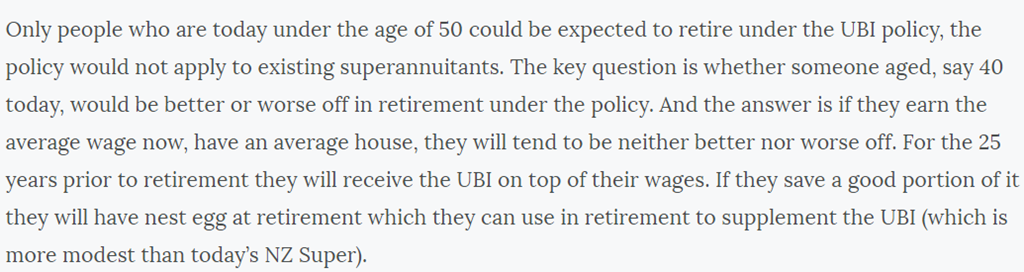
Only people who are today under the age of 50 could be expected to retire under the UBI policy, the policy would not apply to existing superannuitants.

Generation Rent have to pay higher taxes to keep current retirees in the superannuation style they have become accustomed. Those aged over 50 are also grandfathered in to the existing level of income support from New Zealand Superannuation.

Generation Rent will have to save their Universal Basic Income so they do not live in poverty when they retire in as little as 15 years from the date of introduction. As Gareth Morgan explains when referring to 40-year-olds:

For the 25 years prior to retirement they will receive the UBI on top of their wages. If they save a good portion of it they will have nest egg at retirement which they can use in retirement to supplement the UBI (which is more modest than today’s NZ Super).

At least the Labour Party admitted that a Universal Basic Income of $11,000 per adult was inadequate and will have to be supplemented so that no one is left worse off:

After all, $11,000 is a lower income than what is currently paid out as part of New Zealand Super. If the figure is too low, then the benefits of security and freedom promised by a UBI may not be realised.

On the other hand, if the figure is pushed higher, taxes will have to rise, possibly to an unrealistically high figure. (Morgan’s $11,000 UBI is funded through a flat tax of 30%.) There is, therefore, a real feasibility-sufficiency trade-off.

It may be that a UBI has to be supplemented by other transfers to ensure that the most vulnerable groups have enough income.

As for single parents relying on a welfare benefit, they are $150 a week short under a Universal Basic Income. Where is Sue Bradford when you need her to go on about beneficiary bashing.

Gareth Morgan’s proposed solution to this $150 per week cut in the incomes of the needy is to suggest that the non-custodial parent of the child should give up part or all of their Universal Basic Income to support their child:

Each child has two parents, the UBI is paid to both whether they live together or not.

It is totally feasible that the UBI of both parents could be required to be directed to support the children in the event of separation. In the Kahuna the amount paid per family would be $22,000 after tax – more than is paid to a sole parent family now.

This hard line on child support will make being a non-custodial parent of a child a rather risky venture under a Universal Basic Income. A Universal Basic Income is supposed to make you feel very secure against misfortune as Gareth Morgan explained back in 2011:

…let’s agree on what is a minimum income every adult should have in order to live a dignified life and then see what flows from that. We begin by specifying the income level below which we are not prepared to see anyone having to live.

If you are the non-custodial parent and down on your luck – unemployed, sick or an invalid – you cannot rely on your Universal Basic Income as a backstop because part or all of that is already transferred to support your child.

Paternity suits will take on a new meaning because you can lose your Universal Basic Income. The Universal Basic Income with Gareth Morgan’s ad hoc amendments this week has strings attached on whether you or someone else receives your Universal Basic Income. That make or break decision will be up to the Family Court and the Child Support Agency at IRD.

I am not sure how a Universal Basic Income deals with deadbeat dads at home and living abroad. Central to its funding is abolition of the welfare state bureaucracy to save $2 billion.

Those down on their luck will not have a welfare state bureaucracy to turn to if their child support does not come through or have nothing to live on after their child support is paid.

Now let Gareth Morgan explain why he wanted to get rid of that welfare state bureaucracy and replace it with a Universal Basic Income:

We must finally admit that with all the paternalistic will in the world there is no chance that public servants can adequately identify and monitor eligibility for a needs-based benefit regime.

We should save ourselves the torture of continuously getting it wrong and designing an endless stream of discriminatory “fixes” to cover our mistakes in finding targeted perfection.

The reality is that people’s circumstances are dynamic and that they will change their behaviour to suit the design of the benefit regime making the chicken and egg nature of determining “needs” an exercise in futility.

The important thing is to be fair and to have a consensus on the level of income that we all have an unconditional entitlement to in order to live a dignified life.

Gareth Morgan seems to throw Generation Rent and non-custodial parents under the bus to deliver on his dream. They both have to give up much of their Universal Basic Income either to their children or their KiwiSaver to fill the growing number of gaps in his Big Kahuna. Their unconditional entitlement to be able to live a dignified life through a Universal Basic Income of $11,000 per adult has a lot of strings attached to it and cracks to fall through with no safety net.

Wear a condom, do not divorce and do not be under 50 are the secrets to enjoying a Universal Basic Income. If not, you are on your own. Your Universal Basic income is already spoken for.
@garethmorgannz’s #UBI finishes the job on #GenerationRent @JordNZ

Gareth Morgan revealed today a hitherto unnoticed design feature in his Universal Basic Income of $11,000 per annum. It will be phased in over a long time. That will mean that Generation Rent will continue to pay taxes to fund a universal old age pension for their parents and grandparents, but will not be fortunate enough to receive that themselves.

image

Source: Morgan Foundation (2016) Taxpayers Union Critique of the UBI just bonkers – again

They are not left of their own devices. Generation Rent  is expected to save the Universal Basic Income they receive over their working lives to avoid living in poverty in their retirement. Does not strike me as a political winner.

The Morgan Foundation does not understand the implications of time inconsistency for retirement savings policy:

  • Which is better? Save for your retirement through the share market or save to own your own home and then present yourself at the local social security office to collect your taxpayer funded old-age pension?
  • Under this fine game of bluff, you bleed the taxpayer in your old age and pass on your debt-free home to your children.

This strategy of not saving much for retirement is rational for the less well-paid. The family home is exempt from income and asset testing for social security. If you lose you bet, sell your house and live off the capital. For ordinary workers, this is a good bet. The middle class might prefer to live in a more luxurious retirement.

For ordinary workers, whose wages are not a lot more than their old age pension from the government, a government funded pension is a good political gamble. The old-age pension for a couple in New Zealand is set at no less that 60% of average earnings.

Edward Prescott argues for compulsory retirement savings account albeit with important twists because it is otherwise irrational for many to save for their retirement against the background of a welfare state:

The reason we need to have mandatory retirement accounts is not because people are irrational, but precisely because they are perfectly rational — they know exactly what they are doing.

If, for example, somebody knows that they will be cared for in old age — even if they don’t save a nickel — then what is their incentive to save that nickel? Wouldn’t it be rational to spend that nickel instead?

…Without mandatory savings accounts we will not solve the time-inconsistency problem of people under-saving and becoming a welfare burden on their families and on the taxpayers. That’s exactly where we are now.

Before tax child poverty in USA and Scandinavia

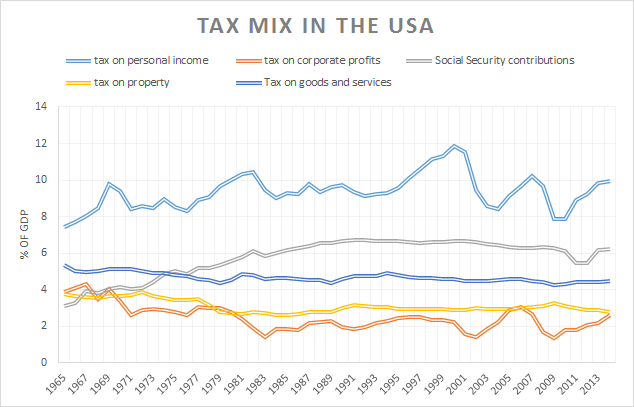
Tax mix in the USA as a percentage of GDP since 1965

The only major change in the US tax mix in the last 50 years has been greater reliance on social security contributions.

image

Source: OECD Stat.

The share going to income taxes bobbing up and down quite a lot in the last 30 years much of that to do with the business cycle. In the 1990s, the share of taxes from personal income increased during boom times. In the Great Recession, the tax share to income tax rose with the declining economy as did that on corporate profits.

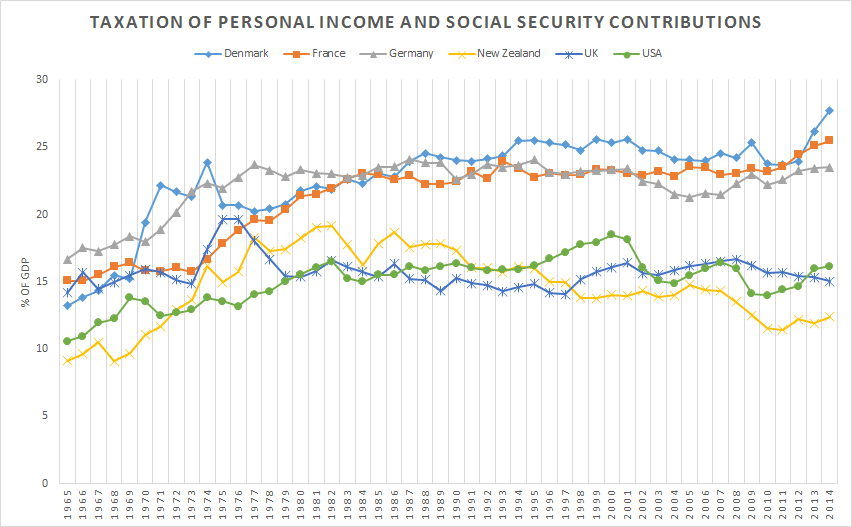
Taxation of personal income and social security contributions as a percentage of US, British, Danish, German, French and New Zealand GDPs since 1965

image

Source: Tax – Social security contributions – OECD Data and Tax – Tax on personal income – OECD Data.

This @amprog conservative antipoverty dictionary does not add up

The only alternative offered by the Centre for American Progress is send them on a course. This response, which is the standard policy response to any labour market crisis, will not solve poverty, mush less inequality.

How did the War on Poverty go?

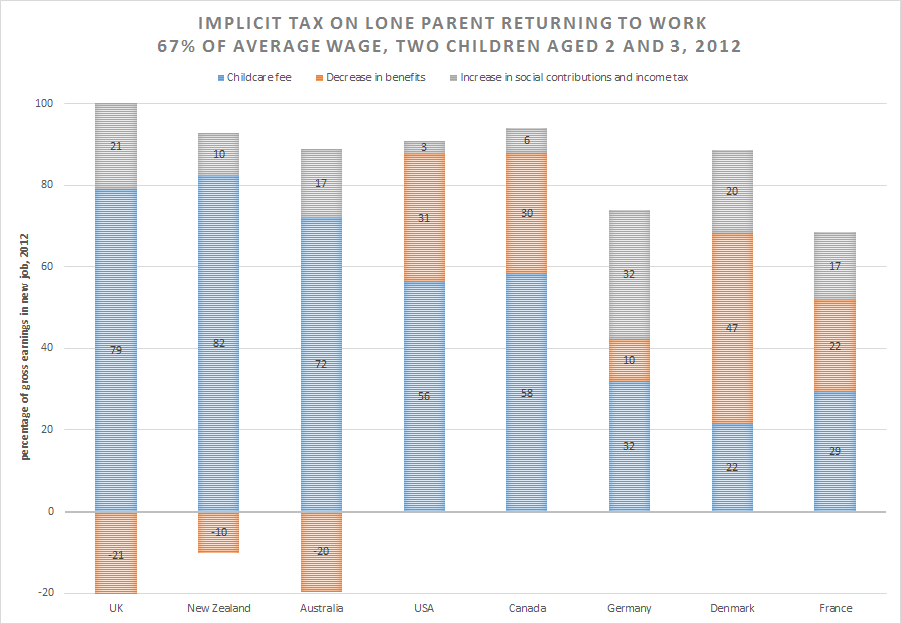
Implicit tax on a lone parent returning to a low-paid job in the USA, UK, Denmark, France, Germany, Canada, Australia and New Zealand

image

Source: Economic Policy Reforms: Going for Growth – OECD (2016).

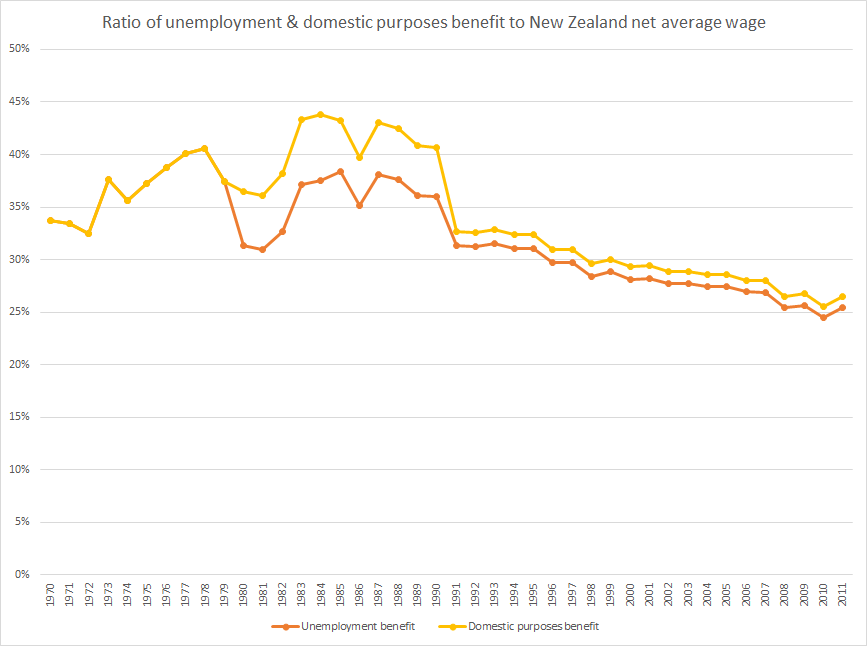
Ratio of unemployment and single parents benefit to the New Zealand net average wage since 1970

image

Source: OECD Economic Survey New Zealand 2015.

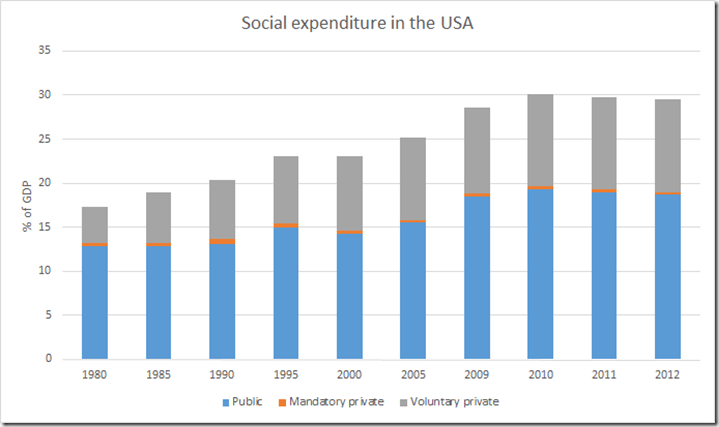
Public, mandatory private and private social expenditure as % of US GDP, selected years since 1980

image

Source: OECD Income Distribution database.

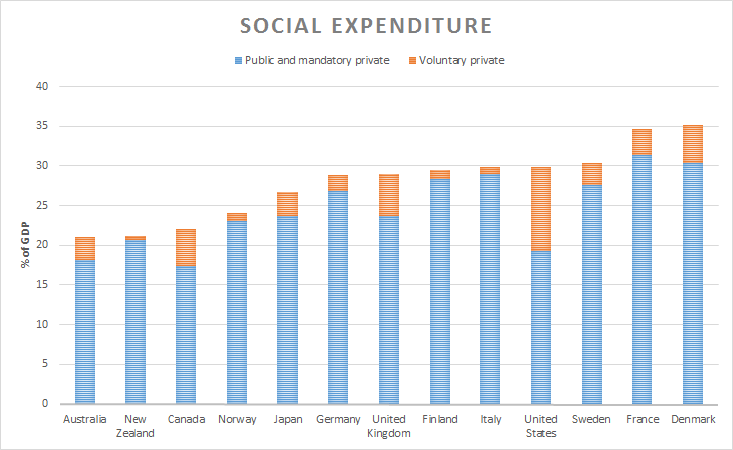
Public, mandatory & voluntary private social expenditure, G7, Nordics, Australia & New Zealand

Mandatory and voluntary private social expenditure makes a big difference to the degree of social insurance in some countries but not others. The calculation of these numbers in purchasing power parity would be much more interesting.

image

Source: OECD Income Distribution database.

% social benefits in cash by income quintile, G7, Nordics, Australia and New Zealand

Some welfare states are much more targeted. Australia has the most targeted welfare state in terms of public social benefits paid in cash to the bottom quintile (Q1) of income earners.

image

Source: OECD Income Distribution database.

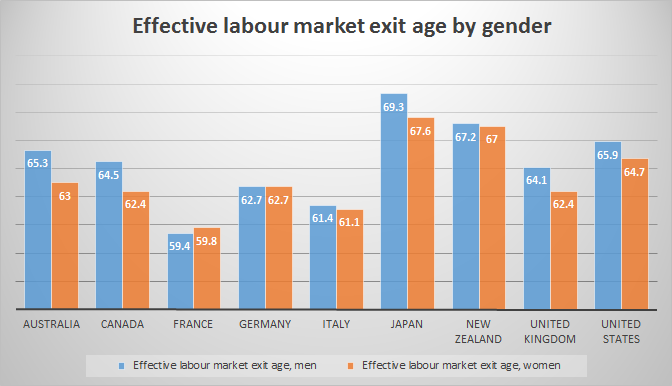
Effective labour market exit age by gender in the G7 countries, Australia and New Zealand

image

Source: OECD Pensions at a Glance 2015.

.

Three different ways of measuring income growth since 1979 in the USA

https://www.facebook.com/592589870775439/photos/pb.592589870775439.-2207520000.1454057624./1145351625499258/?type=3&theater

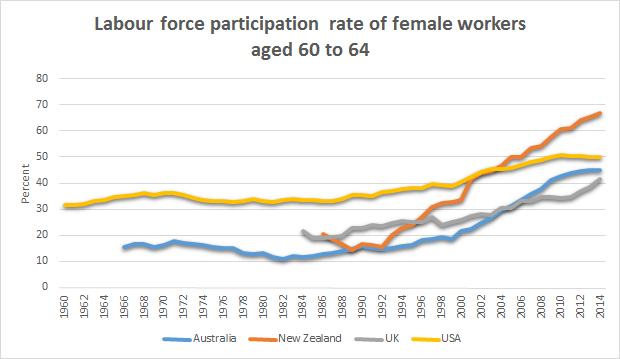
Female labour force participation rate, workers aged 60 to 64, USA, UK, Australia and New Zealand since 1960

The increase in the eligibility age from the age of 60 to the age of 65 for the old age pension in New Zealand clearly sparked an explosion in female labour force participation between these ages.

image

Data extracted on 05 Feb 2016 04:49 UTC (GMT) from OECD.Stat.

Previous Older Entries Next Newer Entries

Bassett, Brash & Hide

Celebrating humanity's flourishing through the spread of capitalism and the rule of law

Truth on the Market

Scholarly commentary on law, economics, and more

The Undercover Historian

Beatrice Cherrier's blog

Matua Kahurangi

Celebrating humanity's flourishing through the spread of capitalism and the rule of law

Temple of Sociology

Celebrating humanity's flourishing through the spread of capitalism and the rule of law

Velvet Glove, Iron Fist

Celebrating humanity's flourishing through the spread of capitalism and the rule of law

Why Evolution Is True

Why Evolution is True is a blog written by Jerry Coyne, centered on evolution and biology but also dealing with diverse topics like politics, culture, and cats.

Down to Earth Kiwi

Celebrating humanity's flourishing through the spread of capitalism and the rule of law

NoTricksZone

Celebrating humanity's flourishing through the spread of capitalism and the rule of law

Homepaddock

A rural perspective with a blue tint by Ele Ludemann

Kiwiblog

DPF's Kiwiblog - Fomenting Happy Mischief since 2003

The Dangerous Economist

Celebrating humanity's flourishing through the spread of capitalism and the rule of law

Watts Up With That?

The world's most viewed site on global warming and climate change

The Logical Place

Tim Harding's writings on rationality, informal logic and skepticism

Doc's Books

A window into Doc Freiberger's library

The Risk-Monger

Let's examine hard decisions!

Uneasy Money

Commentary on monetary policy in the spirit of R. G. Hawtrey

Barrie Saunders

Thoughts on public policy and the media

Liberty Scott

Celebrating humanity's flourishing through the spread of capitalism and the rule of law

Point of Order

Politics and the economy

James Bowden's Blog

A blog (primarily) on Canadian and Commonwealth political history and institutions

Science Matters

Reading between the lines, and underneath the hype.

Peter Winsley

Economics, and such stuff as dreams are made on

A Venerable Puzzle

"The British constitution has always been puzzling, and always will be." --Queen Elizabeth II

The Antiplanner

Celebrating humanity's flourishing through the spread of capitalism and the rule of law

Bet On It

Celebrating humanity's flourishing through the spread of capitalism and the rule of law

History of Sorts

WORLD WAR II, MUSIC, HISTORY, HOLOCAUST

Roger Pielke Jr.

Undisciplined scholar, recovering academic

Offsetting Behaviour

Celebrating humanity's flourishing through the spread of capitalism and the rule of law

JONATHAN TURLEY

Res ipsa loquitur - The thing itself speaks

Conversable Economist

Celebrating humanity's flourishing through the spread of capitalism and the rule of law

The Victorian Commons

Researching the House of Commons, 1832-1868

The History of Parliament

Articles and research from the History of Parliament Trust

Books & Boots

Reflections on books and art

Legal History Miscellany

Posts on the History of Law, Crime, and Justice

Sex, Drugs and Economics

Celebrating humanity's flourishing through the spread of capitalism and the rule of law

European Royal History

Exploring the Monarchs of Europe

Tallbloke's Talkshop

Cutting edge science you can dice with

Marginal REVOLUTION

Small Steps Toward A Much Better World

NOT A LOT OF PEOPLE KNOW THAT

“We do not believe any group of men adequate enough or wise enough to operate without scrutiny or without criticism. We know that the only way to avoid error is to detect it, that the only way to detect it is to be free to inquire. We know that in secrecy error undetected will flourish and subvert”. - J Robert Oppenheimer.

STOP THESE THINGS

The truth about the great wind power fraud - we're not here to debate the wind industry, we're here to destroy it.

Lindsay Mitchell

Celebrating humanity's flourishing through the spread of capitalism and the rule of law

Alt-M

Celebrating humanity's flourishing through the spread of capitalism and the rule of law

croaking cassandra

Economics, public policy, monetary policy, financial regulation, with a New Zealand perspective

The Grumpy Economist

Celebrating humanity's flourishing through the spread of capitalism and the rule of law

International Liberty

Restraining Government in America and Around the World