Joseph Schumpeter on The Great Enrichment
18 Aug 2015 Leave a comment
in applied welfare economics, economic history, entrepreneurship, liberalism Tags: capitalism and freedom, creative destruction, Joseph Schumpeter, The Great Enrichment, The Great Escape, The Great Fact
Everything’s Amazing and Nobody’s Happy
18 Aug 2015 Leave a comment
in applied welfare economics, development economics, economic history, economics of information, economics of media and culture, growth disasters, growth miracles, liberalism Tags: antimarket bias, Bryan Caplan, capitalism and freedom, life expectancies, living standards, pessimism bias, The Great Enrichment, The Great Escape, The Great Fact
The Great Escape is on-going
18 Aug 2015 Leave a comment
in applied welfare economics, development economics, economic history, environmental economics, growth disasters, growth miracles, health economics Tags: child mortality, global poverty, infant mortality, life expectancies, stream poverty, The Great Escape, The Great Fact
https://twitter.com/humanprogress/status/631179133989617665/photo/1
The total number of undernourished persons is falling despite population growth. buff.ly/1MgKWqd #food #health http://t.co/YfAltqvxVy—
HumanProgress.org (@humanprogress) August 11, 2015
Extreme poverty is declining, but more quickly in some places than others. See the data: buff.ly/1DDz0O5 http://t.co/W1a0WpCxHI—
HumanProgress.org (@humanprogress) August 11, 2015
Has the ‘Peak Oil’ drama peaked?
17 Aug 2015 Leave a comment
in economic history, energy economics, entrepreneurship, environmental economics, resource economics Tags: creative destruction, entrepreneurial alertness, peak oil, The Great Enrichment

Remember Peak Oil? Just a few years ago Green Party leaders Jeanette Fitzsimons and Russell Norman routinely issued warnings about ‘the world running out of oil’ and told us that we needed to move freight off roads and on to shipping and rail, and commuters out of cars and on to trains, buses and bicycles.
They weren’t alone of course. An April 2006 article in The Economist reported that:
For years a small group of geologists has been claiming that the world has started to grow short of oil, that alternatives cannot possible replace it and that an imminent peak in production will lead to economic disaster. In recent months this view has gained wider acceptance on Wall Street and in the media. Recent books on oil have bewailed the threat. Every few weeks, its seems, “Out of Gas”, “The Empty Tank” and “The Coming Economic Collapse: How You Can…
View original post 651 more words
Julian Simon on Resources, Growth and Human Progress
17 Aug 2015 Leave a comment
in applied welfare economics, development economics, economic history, energy economics, entrepreneurship, environmentalism, health economics, liberalism, resource economics Tags: capitalism and freedom, commodity prices, creative destruction, entrepreneurial alertness, Julian Simon, life expectancies, peak oil, The Great Enrichment, The Great Escape, The Great Fact
The benefits and costs of the @NZSuperFund since its inception
17 Aug 2015 Leave a comment
in applied price theory, applied welfare economics, economic growth, economic history, entrepreneurship, financial economics, fiscal policy, industrial organisation, labour economics, labour supply, macroeconomics, politics - New Zealand, public economics Tags: ageing society, company tax rate, deadweight cost of taxes, demographic crisis, efficient markets hypothesis, laffer curve, New Zealand superannuation fund, old age pensions, retirement savings, social insurance, sovereign wealth funds, taxation and entrepreneurship, taxation and investment, taxation and labour supply
Most mutual funds still can't beat their benchmark read.bi/1GkTig1 http://t.co/r7ezoDGJbV—
BI Chart of the Day (@chartoftheday) June 03, 2015
The New Zealand Superannuation Fund, the sovereign wealth fund part funding New Zealand’s old-age pension from 2029/2030 onwards, has been a bit of a wild ride. Sometimes the earnings of the Fund were well below and sometimes earning well above the long-term bond rate.

Source: New Zealand Superannuation Fund Annual Report 2014.
Since its inception, the Fund earned an average annual return of 9.78%, which was 5.06% above the long-term bond rate, and 1.03% above its reference portfolio.

No information was given in the annual report of the New Zealand Superannuation Fund on the marginal dead weight cost of the taxes raised to fund the New Zealand Superannuation Fund to see whether there is any net benefit to taxpayers from its establishment and continued operation.
The New Zealand Government has contributed $14.88 billion to the fund from prior its inception in 2001 to the suspension of contributions in 2009 by the incoming National Party Government.
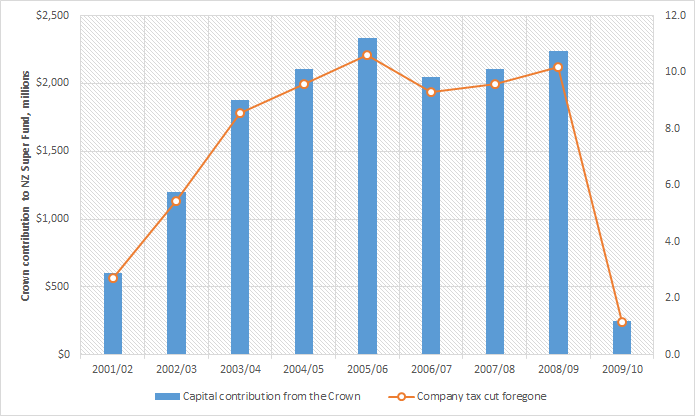
Source: New Zealand Treasury.
Over the nine years in which contributions were made, the company tax rate of 28% could have easily been up to 10 percentage points lower.
The New Zealand Treasury estimates that a one percentage point cut in the company tax costs about $220 million in forgone revenue if there are no other changes to the tax system. These are static estimates that do not include any feedback from greater investment and higher growth.
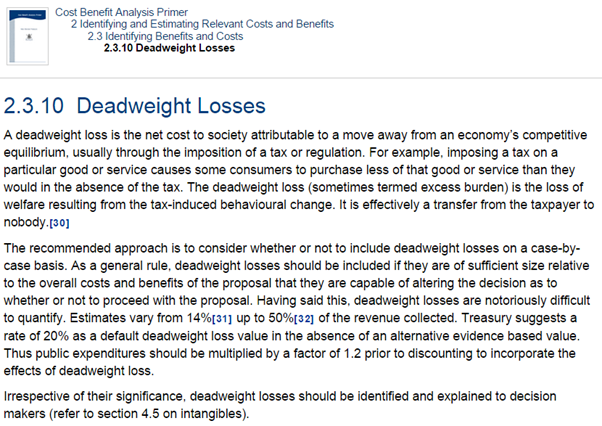
The New Zealand Superannuation Fund must beat the market every single year to make up for the deadweight cost of its funding, a premium for the investment risk added to the Crown’s portfolio and the cost to New Zealand’s growth rate of higher than otherwise taxes on income, entrepreneurship and investment.
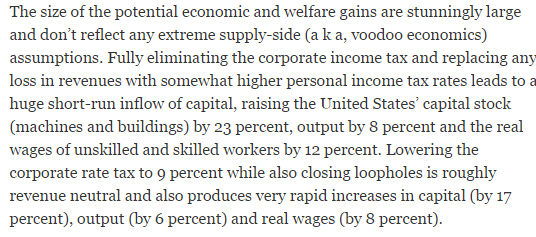
Source: Abolish the Corporate Income Tax – The New York Times.
Incidence of long-term unemployment in the PIGS since 1983
17 Aug 2015 Leave a comment
in business cycles, currency unions, economic growth, economic history, Euro crisis, job search and matching, labour economics, labour supply, macroeconomics, occupational choice, unemployment, unions, welfare reform Tags: employment law, equilibrium unemployment, Greece, Italy, labour market regulation, natural unemployment rate, Portugal, Spain, unemployment duration
The boom that preceded the bust in the Greek economy did nothing for the rate of long-term unemployment among Greeks. Long-term unemployment had been pretty stable prior to the economic boom after joining the euro currency union.
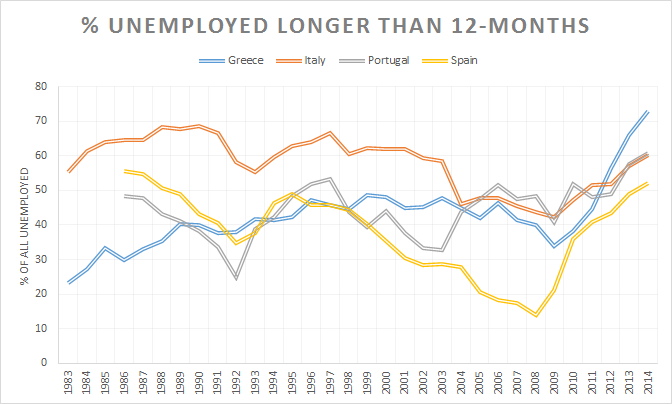
Source: OECD StatExtract.
Nothing much happened to long-term unemployment in Italy or Portugal in recent decades. Spanish long-term unemployment fell in line with the economic boom in Spain over the 1980s and 1990s up until the global financial crisis.
Mises on the role of statistics
16 Aug 2015 Leave a comment
in applied price theory, applied welfare economics, comparative institutional analysis, econometerics, economic history, Ludwig von Mises Tags: methodology of economics, philosophy of economics, statistics
Creative destruction in advertising revenue
16 Aug 2015 Leave a comment
in economic history, economics of media and culture, entrepreneurship, industrial organisation, survivor principle Tags: creative destruction, entrepreneurial alertness, legacy media
Soon American internet-ad revenue will surpass newspapers, magazines and billboards combined econ.st/1GjiIny http://t.co/17pxfdVWcE—
The World in 2015 (@EconWorldin) July 14, 2015
1537 map of the British Isles
16 Aug 2015 Leave a comment
in economic history Tags: British history, maps
Map of the British Isles, presented to King Henry VIII in 1537 http://t.co/d7aYHOy1xM—
Amazing Maps™ (@amazingmap) August 14, 2015
US Teen Pregnancy, Birth and Abortion Rates
16 Aug 2015 Leave a comment
in economic history, gender, labour economics, labour supply, politics - USA, population economics, welfare reform Tags: abortion, economics of fertility, marriage and divorce, single mothers, single parents, teen pregnancy
US Teen Pregnancy, Birth and Abortion Rates since 1972 http://t.co/mwR1U6WJg8—
Max Roser (@MaxCRoser) August 06, 2015
India and Pakistan became independent today
16 Aug 2015 Leave a comment
in constitutional political economy, development economics, economic history, growth disasters, Public Choice Tags: age of empires, British empire, India, Pakistan
This day in 1947 | India and Pakistan independent after some 200 years of British rule: timesmachine.nytimes.com/timesmachine/1… http://t.co/VfbpKayExM—
NYT Archives (@NYTArchives) August 15, 2015
% of unemployment lasting longer than 12 months in Scandinavia since 1976
16 Aug 2015 Leave a comment
in applied welfare economics, business cycles, constitutional political economy, economic history, job search and matching, labour economics, labour supply, macroeconomics, Public Choice, unemployment Tags: borders, deployment subsidies, economics of borders, equilibrium unemployment rate, Finland, labour market programs, long-term unemployment, maps, natural unemployment rate, Norway, Scandinavia, search and matching, Sweden, unemployment durations
As I recall, most unemployed have been unemployed longer than 12 months in Sweden have to go on a labour market program. When they returned to unemployment after the program, the clock starts again. They are deemed to be freshly unemployed rather than adding to the previous spell with an interlude on a make work program. This makes Swedish long-term unemployment data rather unintelligible.
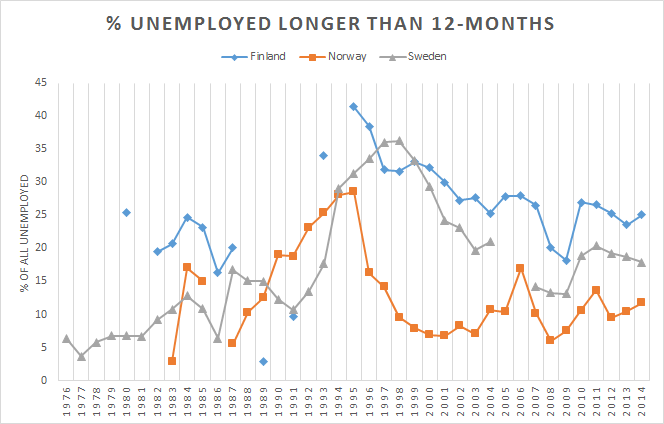
Source: OECD StatExtract.
Finland was recovering from its worst depression since the 1930s and the early 1990s when its data on long-term unemployment started to be continuous. This makes Finnish unemployment data rather difficult to interpret. Norway’s data for the long-term unemployed goes up and down a bit too much to be trustworthy without a background policy narrative.
Why we shouldn’t rely too much on GDP and Human development index to tell us how we are doing
15 Aug 2015 Leave a comment
in applied price theory, applied welfare economics, development economics, economic history, economics of media and culture Tags: measurement error, The Great Enrichment, The Great Escape, The Great Fact

Up to now, I personally think we are yet to come up with a more accurate and adequate way of measuring our welfare, our quality or standard of living, that is, how happy we feel in our lives or how enjoyable and satisfying our lives are. If this is what we are measuring GDP (output) is in so many ways an inadequate measure of welfare because it is concentrating on output, it focuses more on commodities therefore GDP does not capture the happiness and joy got from family and social networks. So some economists have tried to come up with new ways to better measure GDP as a measure of our welfare, and they have broken down welfare into three things that they believe constitute welfare. Firstly, welfare has something to do with consumption of goods and services giving us utility, pleasure, or happiness. Secondly, it also has something to…
View original post 722 more words
Why are ex-Communists still on the Left forgiven for their past?
15 Aug 2015 Leave a comment
in economic history, economics of crime, liberalism, Marxist economics, politics - Australia, politics - New Zealand, politics - USA Tags: autocracy, communism, ex-Communists, genocide, mass murder, reigns of terror, tinpot dictatorships, totalitarian dictatorships
When communism fell, so did mass killings. buff.ly/1PhbuYd #peace http://t.co/kZ3kKD3RI3—
HumanProgress.org (@humanprogress) August 11, 2015


Recent Comments